

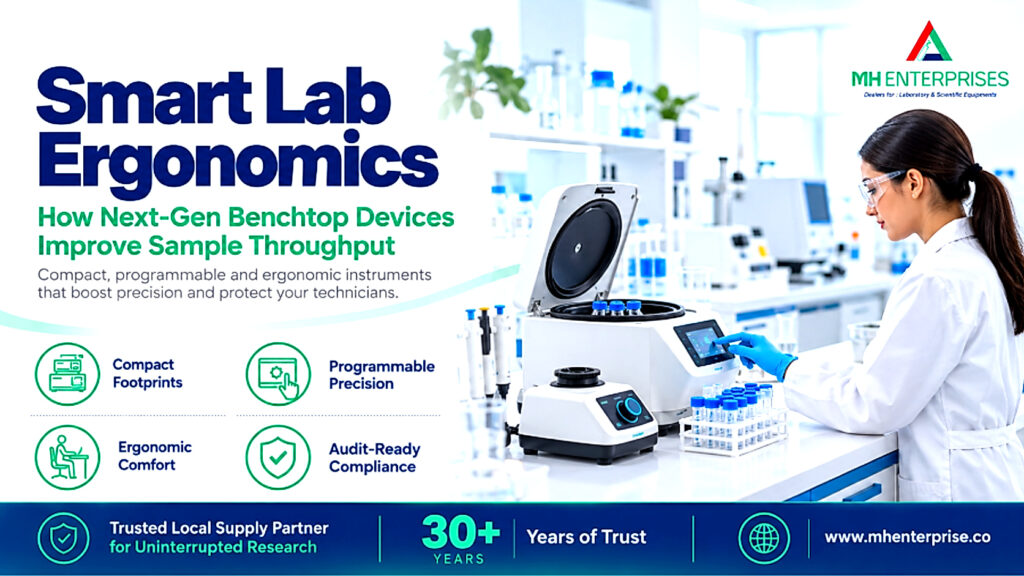
In the fast-paced world of scientific discovery, pharmaceutical development, and clinical diagnostics, laboratory throughput is a defining metric of operational success. Facilities are continuously pressured to process higher volumes of samples in less time, while maintaining flawless precision and strict compliance. Historically, laboratories attempted to meet these demands by scaling up physical space or rushing technicians through manual workflows. However, these traditional approaches inevitably encounter severe limitations, leading to spatial bottlenecks, increased processing mistakes, and physical strain on laboratory staff.
At MH Enterprises, we believe that achieving peak throughput requires a smarter, more integrated approach to workspace design. True laboratory efficiency happens at the intersection of automation and user-focused design. By modernizing a facility’s physical structure and deploying next-generation benchtop instruments, managers can simultaneously increase processing speeds while protecting their most valuable assets: their technicians. Optimizing this dynamic begins with strategic adjustments to your high-level laboratory arrangement.
How Compact Footprints Maximize Limited Laboratory Bench Real Estate
Physical real estate inside an advanced laboratory is exceptionally expensive and strictly limited. As a laboratory takes on new testing projects or expands its diagnostic menu, benches quickly become overcrowded with disjointed equipment pieces, localized clutter, and tangled power cables. This spatial crowding creates serious operational friction, forcing technicians to lose time navigating disorganized workspaces or transporting samples across distant testing zones.
To address these spatial constraints, modern equipment manufacturers are engineering next-generation benchtop instruments with remarkably compact footprints. These sophisticated devices integrate high-capacity processing components into streamlined, vertical enclosures that occupy minimal bench space.
The Structural Strategy of Space Optimization
When structuring a modern laboratory arrangement, layout engineers must prioritize physical flexibility and equipment density:
- Vertical Integration: Next-generation benchtop tools utilize stacked internal components, maximizing functional capabilities while minimizing horizontal workspace usage.
- Multifunctional Design: Modern instruments combine multiple independent preparation steps, such as heating, vortexing, and magnetic separation, into a single compact chassis, eliminating the need for three separate bulky devices.
- Modular Placement: Highly compact benchtop tools allow laboratories to position critical instruments closer together, minimizing sample transport distances and creating a continuous processing flow.
By freeing up valuable bench space through smart instrument selection, facilities can create an open, agile workspace. This spatial optimization directly accelerates throughput, reducing clutter-induced delays and ensuring that technicians can access all essential processing tools easily.
The Role of Microprocessor Control and Programming in Reducing Operator Error
Even in a beautifully organized workspace, manual sample processing introduces significant risks of human error. Repetitive tasks such as setting rotation speeds, tracking incubation times, and manually pipetting volumes are highly susceptible to micro-oversights, particularly during long, high-volume testing shifts. A single miscalculated parameter or skipped sequence can invalidate an entire batch, trigger costly out-of-specification investigations and drastically reduce your processing throughput.
The most effective way to eliminate these vulnerabilities is by shifting operational control from manual human adjustments to deterministic programming. Integrating modern laboratory instrumentation equipped with advanced microprocessor controls fundamentally changes the way samples are processed.
Digital Control Systems and Protocol Consistency
Next-generation benchtop devices feature intuitive digital touchscreens and programmable memory banks, allowing users to save and lock specific operational profiles. Rather than relying on a technician to turn analog dials or monitor manual timers, operators simply select the pre-programmed method from the menu and press start. The internal microprocessor precisely regulates all operational variables:
- Controlled Acceleration Profiles: Eliminates sudden mechanical jerks that cause sample splashing and cross-contamination.
- Dynamic Thermal Uniformity: Ensures every sample tube across a heating block experiences the exact same thermal environment, preserving data consistency.
- Automatic Error Detection: Real-time internal sensors detect balance issues, lid unlatching, or temperature deviations, automatically pausing cycles before samples are compromised.
This level of automation shifts the operator’s role from active physical manipulation to simple protocol supervision. By removing human variance from repetitive cycles, the laboratory supports reproducibility, eliminating the processing delays caused by human error.
Ergonomic Design Choices That Protect Lab Technicians During Long Shifts
While processing precision is vital, sustained laboratory throughput is heavily dependent on operator well-being. Sample preparation is a physically demanding laboratory activity, often requiring technicians to spend hours performing highly repetitive, fine-motor tasks. Poorly designed equipment forces users into awkward postures, demands high muscle force, and causes severe physical fatigue. Over time, these conditions lead to repetitive strain injuries (RSIs) and increased absenteeism, which severely disrupt facility operations.
To protect workers from these physical risks, modern benchtop equipment features specialized ergonomic optimizations. These enhancements reduce physical strain, ensuring that technicians can perform long sample prep shifts safely, comfortably, and efficiently.
Key Ergonomic Innovations in Modern Enclosures
- Low-Force Mechanical Interfaces: Next-generation instruments replace stiff, physical levers with soft-touch buttons and electronic lid-locking mechanisms, lowering physical exertion forces by up to 80%.
- Optimized Display Angles: High-contrast digital screens are angled to align perfectly with an operator’s natural line of sight, eliminating neck strain caused by slouching or squinting.
- Low-Profile Architecture: Modern benchtop instruments feature reduced deck heights, allowing technicians to insert or retrieve samples with a natural, relaxed wrist angle, whether sitting or standing.
- Acoustic Dampening Materials: Advanced brushless motors and internal insulation lower operational noise levels, protecting technicians from auditory fatigue during long working hours.
When a facility integrates a user-focused modern laboratory apparatus, it directly protects the physical safety of its workspace. Comfortable technicians work with greater focus and speed, driving higher throughput while substantially reducing the likelihood of fatigue-induced errors.
Verifying Systems with Advanced Metrology Hardware
Deploying ergonomic hardware is only the first step; facilities must verify that these automated instruments consistently operate within strict regulatory tolerances. This continuous validation requires a comprehensive array of specialized quality control and calibration instruments.
Maintaining Validation and Compliance
To maintain an audit-ready facility, managers must use precise verification tools to regularly assess the performance of their programmable benchtop instruments. This includes utilizing traceable digital tachometers to verify rotor speeds, using certified thermistors to validate heating blocks, and running automated software diagnostics to confirm microprocessor calibration. Consistent deployment of advanced QA validation equipment proves to regulatory inspectors that your ergonomic, next-gen devices are helping improve consistency and safeguarding the integrity of analytical data.
Beyond performance verification, facilities must ensure that efficiency improvements do not compromise employee safety or regulatory compliance.
Enhancing Workspace Safety with Specialized Engineering Controls
Ergonomic efficiency must never come at the expense of operator safety. When technicians process volatile chemicals, hazardous biological agents, or heavy industrial materials, the benchtop equipment must function in unison with robust laboratory safety infrastructure.
Comprehensive Personnel Protections
Modern sample processing requires multi-layered safety barriers to isolate operators from operational hazards. Next-generation benchtop devices feature built-in containment features, such as aerosol-tight rotors, integrated chemical filtration hoods, and interlocking protective shields, designed to work alongside your facility’s integrated safety systems. Standardizing on instruments that prioritize these safety elements ensures that your facility remains fully compliant with occupational health guidelines, allowing teams to handle hazardous materials securely.
The Strategic Value of Ergonomic Lab Modernization
Upgrading your benchtop infrastructure involves a significant capital commitment, but the long-term operational advantages extend across the entire organization:
- Substantial Efficiency Gains: Minimizing manual processing steps and reducing human errors allows laboratories to process significantly higher sample volumes daily.
- Reduced Operator Fatigue: Ergonomic hardware mitigates physical strain, lowering worker injury rates and fostering a healthier, more productive laboratory workspace.
- Secure Compliance Tracking: Microprocessor-controlled instruments capture detailed electronic logs of every run, ensuring absolute data traceability during regulatory audits.
Ultimately, standardizing on user-focused, intelligent benchtop devices creates an institutional culture centered around operational excellence, precision, and workplace safety.
Partnering with MH Enterprises for Workflow Excellence
At MH Enterprises, we recognize that modern laboratories cannot achieve peak throughput by relying on outdated, manual equipment. True workflow optimization requires a comprehensive strategy that blends intelligent layout planning, precise automation, and user-focused ergonomic hardware.
We specialize in providing high-performance analytical systems, custom benchtop instruments, and tailored infrastructure elements engineered to bring proven reliability for steady performance. Our technical specialists work closely with lab managers to analyze layout bottlenecks, source the ideal laboratory apparatus for your specific workflows and deliver the validation tools and quality assurance equipment required to maintain total regulatory compliance.
Don’t let crowded benches, manual entry errors, or technician fatigue limit laboratory productivity or delay critical testing timelines. Optimize your laboratory arrangement and workflow design, protect your team with advanced certified laboratory safety equipment, and elevate your facility’s throughput with absolute confidence.