

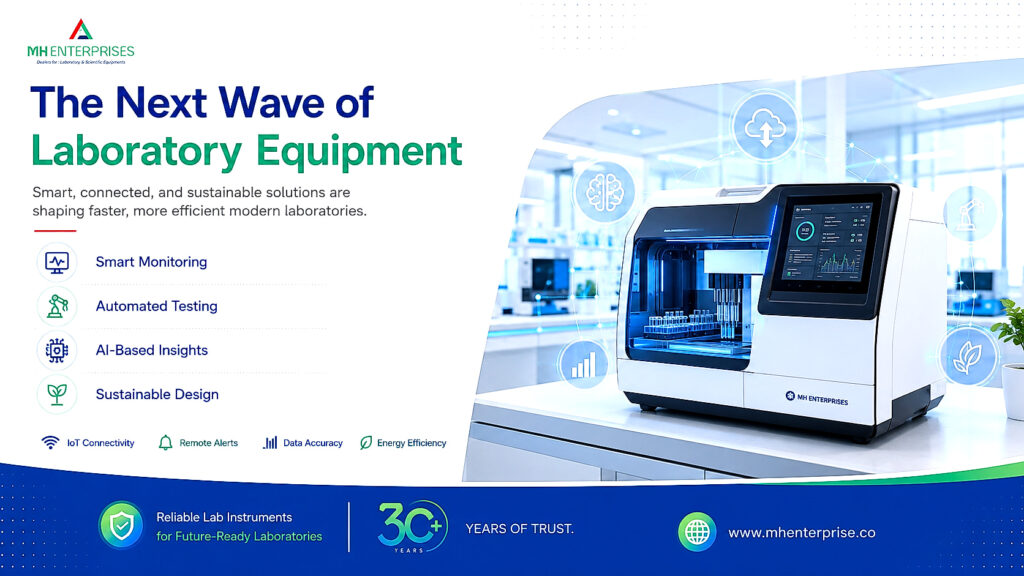
Tomorrow’s Labs Will Be Smarter, Faster, and Greener
The laboratory industry is evolving at an unprecedented pace. As scientific research becomes more sophisticated and industries demand greater efficiency, laboratories are increasingly embracing advanced technologies to improve productivity, accuracy, and sustainability.
The future laboratory will not simply be a place filled with instruments. Instead, it will be a connected, intelligent, and highly automated environment where data flows seamlessly, processes are optimized, and decisions are supported by real-time insights.
Tomorrow’s labs will be smarter, faster, and greener.
From pharmaceutical research centers and environmental testing laboratories to industrial quality control facilities, organizations are investing in innovative solutions that help them stay competitive in an increasingly technology-driven world.
As a trusted Laboratory Equipment Supplier, MH Enterprises remains committed to helping laboratories adapt to these changes through reliable and future-ready solutions.
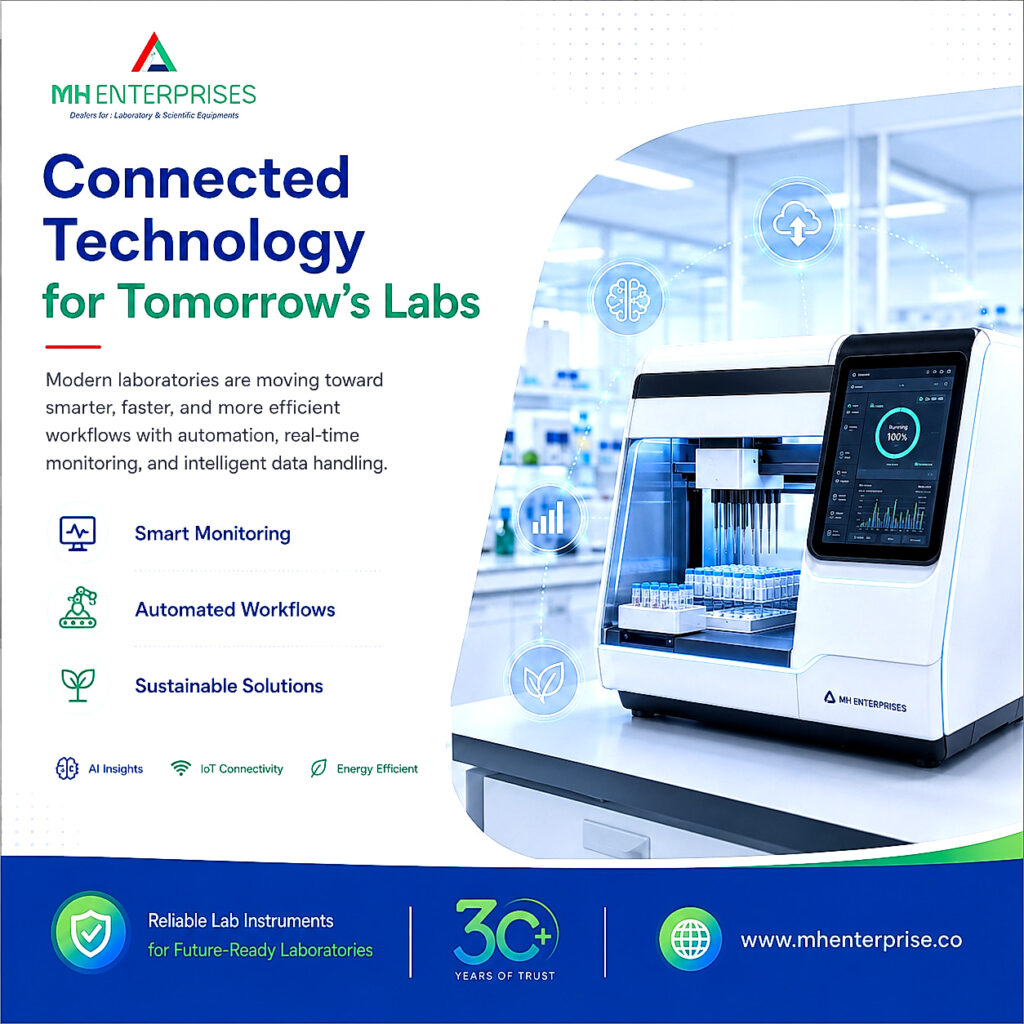
Why Innovation Matters in Modern Laboratories
Laboratories today face numerous challenges, including:
- Growing sample volumes
- Increasing regulatory requirements
- Rising operational costs
- Demand for faster results
- Sustainability expectations
Traditional laboratory methods often struggle to keep pace with these demands.
Innovation is helping laboratories overcome these challenges by introducing:
- Automation
- Digital connectivity
- Artificial Intelligence (AI)
- Internet of Things (IoT) integration
- Sustainable equipment solutions
Organizations that embrace these Laboratory Technology Trends are better positioned to improve efficiency, reduce costs, and maintain competitive advantages.
Trend #1: The Rise of Smart Lab Equipment
One of the most significant developments in recent years is the growth of Smart Lab Equipment.
Unlike conventional laboratory instruments, smart equipment can communicate with software systems, collect operational data, and provide real-time performance monitoring.
Benefits of Smart Lab Equipment
Real-Time Monitoring
Researchers can track equipment performance and testing progress instantly.
Improved Data Accuracy
Automated data collection reduces manual entry errors.
Enhanced Traceability
Digital records support quality control and compliance requirements.
Better Decision-Making
Real-time insights help laboratory managers optimize operations.
As laboratories continue to digitize their workflows, smart instruments are becoming essential tools for modern scientific environments.
Trend #2: Automated Testing Instruments
Automation is transforming laboratory operations across every industry.
Modern Automated Testing Instruments can perform repetitive and time-consuming tasks with minimal human intervention.
Advantages of Automation
- Faster sample processing
- Increased testing capacity
- Improved repeatability
- Reduced human error
- Greater operational efficiency
For example, automated analytical systems can process hundreds of samples while maintaining consistent testing conditions.
This allows laboratory professionals to focus on data interpretation and research rather than routine manual tasks.
Trend #3: Artificial Intelligence in Laboratory Analysis
Artificial Intelligence is rapidly becoming one of the most exciting innovations in laboratory science.
AI-powered systems can analyze vast amounts of data and identify patterns that may not be immediately visible to human researchers.
Applications of AI in Laboratories
Predictive Maintenance
AI can detect equipment performance issues before failures occur.
Advanced Data Analysis
Machine learning algorithms help researchers interpret complex datasets more efficiently.
Quality Control Enhancement
AI systems can identify anomalies and improve product consistency.
Faster Research Outcomes
Researchers can process information more quickly and accelerate innovation.
As AI technology continues to advance, laboratories will increasingly rely on intelligent systems to improve efficiency and analytical accuracy.
Trend #4: IoT-Enabled Laboratories
The Internet of Things (IoT) is creating a new generation of connected laboratory environments.
IoT-enabled instruments can communicate with each other and share operational data in real time.
Benefits of IoT Integration
Remote Monitoring
Laboratory managers can monitor equipment performance from virtually anywhere.
Reduced Downtime
Automatic alerts notify users when maintenance is required.
Improved Resource Management
Connected systems help optimize equipment usage and scheduling.
Enhanced Data Accessibility
Researchers can access critical information more quickly and efficiently.
The combination of IoT and Smart Lab Equipment is helping laboratories become more responsive and productive.
Trend #5: Sustainable and Eco-Friendly Laboratory Equipment
Sustainability has become a major focus for laboratories around the world.
Organizations are increasingly seeking solutions that reduce environmental impact while maintaining high performance standards.
Key Sustainability Trends
Energy-Efficient Instruments
Modern equipment consumes less power without compromising functionality.
Eco-Friendly Materials
Manufacturers are incorporating recyclable and environmentally responsible materials into equipment design.
Reduced Waste Generation
Advanced systems help minimize reagent consumption and laboratory waste.
Longer Equipment Lifespans
Durable products reduce replacement frequency and environmental impact.
These developments are helping laboratories align scientific innovation with environmental responsibility.
The Emergence of Digital Laboratory Management
Laboratories are increasingly adopting digital platforms to improve workflow efficiency.
Benefits of Digital Laboratory Systems
- Centralized data management
- Improved collaboration
- Automated reporting
- Enhanced compliance monitoring
- Better recordkeeping
Digital transformation is becoming an essential component of modern laboratory operations.
Organizations that invest in digital systems often experience significant improvements in productivity and efficiency.
How Innovation Benefits Laboratory Buyers
Investing in modern laboratory technology offers several advantages.
Improved Productivity
Automation and smart systems reduce manual workloads.
Greater Accuracy
Advanced instruments improve testing precision and consistency.
Better Compliance
Digital documentation supports regulatory requirements.
Reduced Operating Costs
Efficient equipment lowers maintenance and resource consumption.
Future-Ready Operations
Innovative laboratories are better prepared for changing industry demands.
These benefits make modern laboratory technology a valuable investment for organizations seeking long-term growth.
How MH Enterprises Supports Laboratory Innovation
At MH Enterprises, we understand that laboratories require solutions that evolve alongside technological advancements.
As a trusted Laboratory Equipment Supplier, we help customers access:
- Advanced Smart Lab Equipment
- Reliable Automated Testing Instruments
- Modern analytical technologies
- High-performance testing solutions
- Sustainable laboratory equipment
Our commitment to innovation ensures that laboratories can adopt new technologies without compromising reliability or performance.
By staying informed about emerging Laboratory Technology Trends, MH Enterprises continues to support laboratories as they prepare for the future.
What the Future Holds
The next generation of laboratories will be characterized by:
- Intelligent automation
- AI-driven analysis
- IoT-enabled connectivity
- Sustainable operations
- Faster and more accurate testing
Laboratories that embrace these innovations today will be better positioned to succeed tomorrow.
The future of laboratory science is not only about technological advancement—it is about creating smarter systems that enable researchers and organizations to achieve more while using fewer resources.
Conclusion
The future of laboratory operations is being shaped by innovation, connectivity, automation, and sustainability.
From Smart Lab Equipment and Automated Testing Instruments to AI-powered analytics and IoT-enabled laboratories, technology is transforming the way scientific research and industrial testing are conducted.
Organizations that stay ahead of these trends will benefit from greater efficiency, improved accuracy, and stronger competitive advantages.
Stay ahead of innovation with MH Enterprises. Partner with us to discover future-ready laboratory solutions designed to support scientific excellence, operational efficiency, and sustainable growth.