

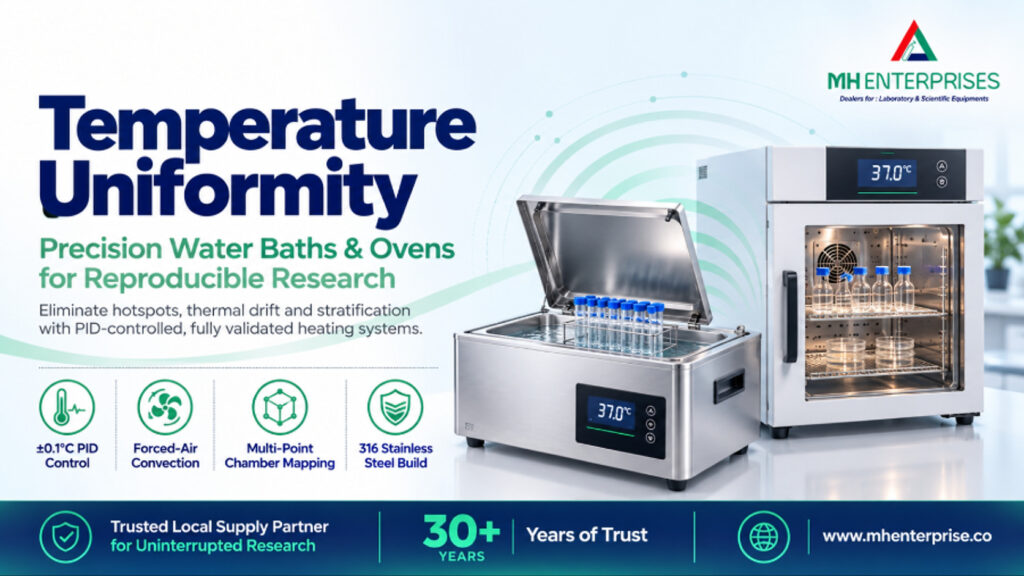
In the execution of modern scientific experimentation, material testing, and biomedical diagnostics, thermal control is a core technical requirement. Thousands of chemical reactions, cellular growth cycles, and material curing processes depend entirely on the application of heat. However, a critical division exists between simply raising the temperature of a sample and achieving true, high-repeatability thermal distribution. While basic heating tools can easily warm a container, they often fail to maintain uniform thermal energy across three-dimensional space over extended time periods.
In a high-precision research facility, spatial thermal variances represent a major vulnerability. If one side of an incubation chamber or water bath is even a fraction of a degree warmer than the other, the resulting data becomes compromised. At MH Enterprises, we believe that true experimental reproducibility requires looking past basic thermal utilities toward highly engineered instruments. Ensuring absolute consistency across your thermal workflows begins with a deep look at the physical architecture, structural insulation, and digital sensor controls embedded within your core heating systems.
The Physics of Thermal Control: Basic Heating Versus Precision Distribution
To build a reliable thermal setup, it is vital to understand why standard heating elements often fail to meet strict research criteria. In a typical laboratory, basic heating instruments rely on raw, localized heat transfer. For instance, a traditional laboratory heater plate transfers thermal energy upward through direct conduction to warm the bottom of a container. While a planar laboratory heater plate is highly effective for basic boiling, solvent evaporations, or high-temperature extractions, it is inherently poorly suited for tasks requiring tight spatial uniformity.
Overcoming Thermal Stratification
When liquid or air inside a chamber is heated from a localized source, natural physics causes thermal stratification. Warmer molecules become less dense and rise, while cooler fluid or air sinks toward the bottom, creating persistent temperature layers. In a standard water bath or convection oven, this stratification leads to measurable differences between the centre, corners, and edges of the working volume.
Precision water baths and laboratory ovens overcome this physical limitation by using advanced convective engineering. Instead of relying on a singular heating point, these specialized devices utilize surrounded heating jackets combined with continuous mechanical circulation. In high-performance water baths, automated impellers circulate the fluid media constantly, eliminating boundary layers and ensuring that every millilitre of water shares an identical kinetic energy profile. Similarly, forced-air convection ovens use balanced fans to move air uniformly across internal shelving arrays, turning a basic heating chamber into a highly consistent thermal zone.
Protecting Fragile Workloads: Why Stability Matters in Biological and Diagnostic Labs
For clinical diagnostic facilities and advanced life science laboratories, maintaining absolute thermal stability is not merely a matter of efficiency; it is an absolute requirement for sample survival. Biological materials, such as primary cell cultures, enzymes, bacterial strains, and blood products, are incredibly sensitive to their environmental surroundings.
The High Stakes of Micro-Variations
Many biological entities operate within highly restricted thermal windows. For example, mammalian cells cultivated inside a modern science laboratory require a constant environment of exactly 37.0°C to mirror physiological conditions. If the temperature inside an incubator drifts upward by as little as 1.5°C, the delicate proteins within the cell walls begin to denature, causing rapid cellular death and ruining weeks of cultivation. Conversely, if the temperature drops below the target zone, cellular metabolism slows down significantly, resulting in sluggish growth curves and inaccurate experimental conclusions.
Furthermore, molecular diagnostic workflows, such as Polymerase Chain Reaction (PCR) preparation or enzyme-linked immunosorbent assays (ELISA), depend entirely on strict enzyme kinetics. Enzymes are biological catalysts whose reaction velocities are bound to specific thermal baselines. A minor temperature deviation across an assay plate means different wells will process at different rates, producing highly variable outcomes. Standardizing on specialized equipment used in science lab settings ensures that every single tube or microplate well experiences identical thermal parameters, safeguarding delicate specimens and ensuring reproducible diagnostic results.
Eliminating Hotspot Errors Through Chamber Mapping and Validation
Even when utilizing advanced, forced-convection ovens or circulated water baths, physical systems can experience drift over years of intensive daily operation. Over time, internal fan motors can lose velocity, heating coils can degrade unevenly, and door gaskets can develop minor leaks. These mechanical changes introduce silent, invisible hotspots or cold zones within the chamber, creating a hidden vulnerability for your quality control workflows.
To prevent these hidden anomalies from compromising your data, facilities must implement structured calibration and spatial verification protocols. This validation process involves checking the instrument’s performance against its original, verified laboratory specifications.
Executing Multi-Point Spatial Audits
Validating an incubation chamber or drying oven requires looking past the single temperature display on the front console. True calibration demands a comprehensive multi-point spatial audit, typically executed using a specialized array of thermocouples:
- Grid-Based Sensor Distribution: Technicians place multiple independent temperature sensors throughout the interior chamber, ensuring sensors are positioned in all eight corners, the geometric centre, and immediately adjacent to the door seal.
- Continuous Environmental Logging: The sensors log temperature values simultaneously over several hours, capturing thermal dynamics during heating cycles, stabilization periods, and door-opening events.
- Hotspot Identification and Correction: The resulting data profile creates a complete three-dimensional thermal map of the chamber. If any sensor deviates from the target baseline beyond allowed tolerances, engineers can adjust internal air baffles or recalibrate the digital controller to bring the system back into balance.
By consistently executing these spatial mapping profiles, lab managers transform their heating units from unverified utilities into precision analytical platforms, satisfying strict regulatory standards and ensuring absolute data integrity.
Engineering Resilience: Sourcing Durable Physical Infrastructures
To maintain tight thermal tolerances over decades of continuous use, the physical components of your heating systems must be engineered for industrial-grade durability. A precision thermal chamber is subjected to continuous stress from high temperatures, humidity, and volatile chemical vapours, meaning low-grade materials will rapidly degrade and compromise containment efficiency.
Constructing Insulated Barriers
When evaluating high-performance heating ovens and water baths, pay close attention to the structural quality of the underlying laboratory hardware. The internal chamber walls should be composed of seamless, heavy-gauge 316-grade stainless steel. This material exhibits exceptional resistance to corrosion, preventing rust formation when exposed to water baths or humidified atmospheres.
Furthermore, the insulation barrier sandwiched between the internal liner and the outer casing must feature advanced, high-density insulation materials, such as ceramic fiber or compressed rock wool. Premium insulation prevents heat from escaping into the room, reducing your energy costs and ensuring the internal air workspace remains entirely unaffected by external drafts or fluctuating room temperatures.
Precision Control Interfaces
Beyond the physical steel chassis, the electronic interface forms the brain of the thermal system. Modern water baths and ovens utilize advanced Proportional-Integral-Derivative (PID) microprocessors to regulate heating profiles.
Unlike basic on/off switches that cause wide temperature swings, a PID controller constantly computes the variance between the actual temperature and the setpoint, adjusting electrical current to the heating element in micro-pulses. This smart regulation prevents temperature overshooting and maintains a stable flat-line profile within ±0.1°C of your target parameter, delivering the ultimate level of precision required for advanced materials testing or biological research.
Optimizing Material Workflows with Quality Consumables
Achieving ideal thermal results requires a holistic look at the entire experimental workspace. Even with a perfectly calibrated oven or water bath, using low-quality consumables or unoptimized containers can lead to poor heat transfer and inconsistent results.
Enhancing Heat Transfer Kinetics
Every material possesses a unique thermal conductivity rating. When heating samples inside a water bath or oven, the composition of the sample vessels heavily influences how quickly and evenly heat reaches the materials. For example, thick-walled glass jars or low-grade plastic tubes can act as thermal barriers, delaying sample warming and creating temporary temperature imbalances.
To maximize throughput and ensure uniform heating, laboratories should utilize high-purity, thin-walled borosilicate glass or highly conductive metal racks. Standardizing on precision-engineered sample vessels ensures that the materials respond rapidly and uniformly to ambient thermal changes, maximizing your operational efficiency.
Partnering with MH Enterprises for Absolute Thermal Precision
At MH Enterprises, we recognize that modern research demands absolute certainty at every stage of your workflow. True experimental validity cannot be achieved by relying on outdated, unverified heating equipment that exhibits wide spatial temperature swings and unreliable control. To maintain strict compliance with global quality guidelines, your thermal instrumentation must deliver reliable and consistent repeatability day after day.
We specialize in supplying a premium catalogue of high-performance equipment used in science lab environments, including circulated water baths, forced-convection ovens, and multi-point validation hardware. Our team of technical consultants works closely with facility managers to evaluate layout needs, source specialized laboratory hardware built for long-term structural resilience, and deliver instruments that easily meet your target laboratory specifications.
Eliminating hidden hotspots, temperature drift, and unverified thermal distribution safeguards sensitive biological cultures and strengthens critical quality-control testing. Contact MH Enterprises today to discuss your application requirements and identify the water bath, laboratory oven, or tailored lab heating solution best suited to your workflow, temperature range, capacity, and compliance needs.