

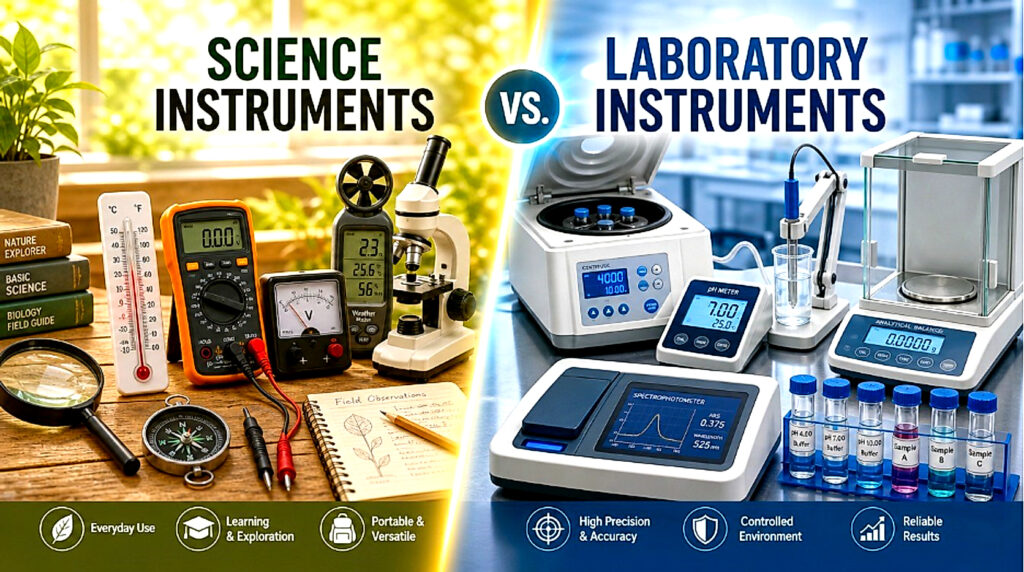
Many students, researchers, and procurement managers use the terms science instrument and laboratory instrument interchangeably. In practice, the terms often overlap, but laboratory instrument usually refers more specifically to tools intended for lab-based testing, measurement, or analysis.
Broadly speaking, a science instrument is a tool used in scientific work to observe, measure, test, or analyze phenomena. A laboratory instrument is typically a scientific instrument used within a laboratory setting, often with greater emphasis on controlled operation, repeatability, documentation, or compliance depending on the application.
This guide explains how the terms are commonly used and where meaningful differences may matter in purchasing, lab setup, and vendor comparison. It is best read as a practical framework rather than a strict industry-wide rule, since terminology can vary by field, supplier, and use case.
Understanding Science Instruments: The Broader Category
A science instrument can be understood as a tool, device, or piece of equipment used to observe, measure, record, test, or manipulate physical, chemical, or biological phenomena in scientific work. It is a broad term that may include simple classroom tools, portable field devices, and advanced analytical systems.
Key Characteristics of Science Instruments
Wide application range: Used in fields like physics, chemistry, biology, astronomy, geology, and environmental science across diverse settings.
Diverse environments: Can be used in labs, field sites, classrooms, industrial facilities, or outdoor locations where conditions vary significantly.
Varying precision levels: From simple tools like magnifying glasses measuring to the nearest millimeter to complex devices like particle accelerators operating at subatomic scales.
Educational to research-grade: Ranges from student-grade science instrument for teaching basic concepts to cutting-edge research equipment pushing the boundaries of human knowledge.
Common Examples of Science Instruments
Basic tools: Rulers, thermometers, magnifying glasses, kitchen balances, and simple voltmeters used in everyday scientific activities.
Measurement devices: Multimeters, oscilloscopes, basic spectrophotometers, and handheld GPS units for field measurements.
Observation tools: Student microscopes, amateur telescopes, digital cameras, and binoculars for visual scientific observation.
Field equipment: Portable weather stations, soil testers, water quality testers, and ruggedized science instrument designed for outdoor use.
Advanced research tools: Mass spectrometers, electron microscopes, chromatography systems, and NMR spectrometers for sophisticated analysis.
Where Science Instruments Are Used
Classrooms: Teaching science instrument for student experiments in schools and universities where durability and cost matter most.
Field research: Portable science instrument for environmental monitoring, geological surveys, or agricultural assessment outside controlled environments.
Industrial settings: Quality control laboratory instruments in manufacturing plants where production speed matters alongside accuracy.
Research facilities: High-precision scientific laboratory instruments for discovery work in academic and corporate research centers.
Healthcare: Diagnostic laboratory instruments in hospitals and clinics for patient testing and disease diagnosis.
A practical takeaway is that many laboratory instruments are also science instruments, while the broader science-instrument category can also include classroom, field, and general-purpose tools that are not primarily intended for laboratory workflows.
Quick Comparison Table
| Aspect | Science Instrument | Laboratory Instrument |
| Scope | Broader term for instruments used in scientific work | More specific term for instruments used in lab settings |
| Typical setting | Classrooms, field sites, workshops, labs | Controlled laboratory environments |
| Precision | May range from basic to advanced | Often selected for higher repeatability and tighter control |
| Documentation | May rely on manual or simple records | Often includes stronger data recording and traceability features |
| Compliance | Usually fewer formal compliance demands | May need calibration, validation, or regulatory support |
The 6 Critical Differences You Need to Know
Difference 1: Precision and Accuracy Requirements
Science instruments used in classrooms or field work may prioritize ease of use, portability, and cost over very high analytical precision. By contrast, laboratory instruments are often selected for more repeatable measurements, tighter tolerances, and better suitability for controlled testing environments.
For example, a classroom thermometer may provide a simple approximate reading, while a laboratory pH meter is designed for finer measurement and routine calibration in analytical work.
Difference 2: Environmental Conditions
Many general science instruments are chosen for flexibility across classrooms, workshops, or field conditions. Many laboratory instruments, on the other hand, are designed to perform best in stable indoor environments where temperature, humidity, cleanliness, and vibration are better controlled.
As a result, some laboratory instruments may be less suitable for harsh outdoor or mobile use unless they are specifically engineered for that purpose.
Difference 3: Calibration and Maintenance
Calibration expectations usually depend on risk, intended use, manufacturer guidance, and whether the instrument supports regulated work. Educational tools may be checked less formally, while laboratory instruments used in research, quality control, or regulated environments often require scheduled calibration and documented records.
Some laboratory instruments also include software-based checks, reminders, or diagnostics, although this varies widely by model and manufacturer.
Difference 4: Data Recording and Documentation
Some general science instruments provide only manual readings or basic digital output, so results may be recorded separately. Many modern laboratory instruments offer stronger data-handling features such as electronic records, export functions, and, in regulated settings, audit-trail capabilities.
These features are especially important in regulated environments, where electronic records may need to meet data-integrity and traceability expectations such as those associated with FDA 21 CFR Part 11.
Difference 5: Price and Investment Level
Cost can differ substantially. Basic classroom or general-purpose science instruments are often relatively affordable, while professional laboratory instruments can require a much higher upfront investment because of performance specifications, software, validation support, serviceability, and compliance documentation.
Higher-end laboratory instruments may also come with stronger service support, training, qualification assistance, and longer-term parts availability, all of which can matter in high-use environments.
Difference 6: Regulatory Compliance
Regulatory expectations depend heavily on the industry and intended use. General science instruments may only need standard safety or electrical conformity requirements, while laboratory instruments used in clinical, pharmaceutical, food, or accredited testing environments may need validation, calibration traceability, and documentation that supports the applicable regulatory or quality framework.
Depending on the supplier and application, this documentation may include calibration records, qualification documents, validation support, and detailed operating manuals.
Consider Your End-Use Carefully To Pick Better
Ask these questions before purchasing:
- Where will this science instrument be used (lab, field, classroom)?
- What accuracy level does my application actually require?
- Do I need calibration certificates for scientific laboratory instruments?
- Will this equipment be used daily or occasionally?
- What’s my total budget including maintenance for laboratory instruments?
Choosing the right type prevents overspending on unnecessary precision or underinvesting in critical science laboratories equipment that could compromise your results.
Choosing the Right Instrument for the Job
The main point is practical rather than absolute: science instrument is a broad term, while laboratory instrument usually refers to instruments intended for lab-based testing, measurement, or analysis.
When evaluating options, focus less on the label and more on the actual requirements: measurement performance, operating environment, calibration needs, data handling, service support, and any compliance obligations relevant to your work.
Using that approach can help prevent purchasing mistakes and ensure your laboratory or educational setting has equipment that matches its real needs, budget, and documentation requirements.
Ready to find the right equipment for your science laboratories?
Contact MH Enterprises for help comparing instruments based on application, performance, budget, and documentation needs.