

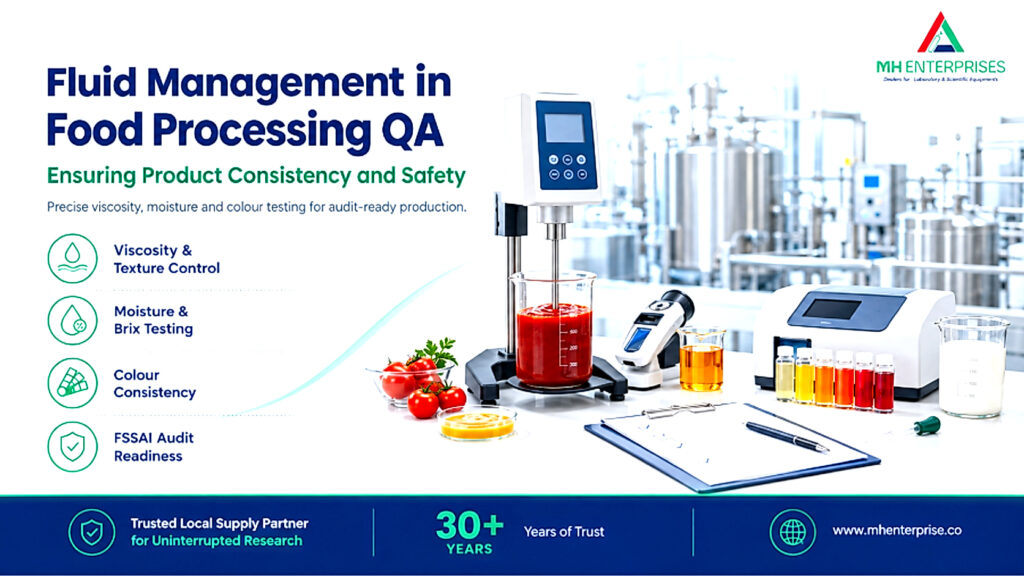
In food processing, fluid management refers to the measurement and control of liquid or semi-solid product properties during production. This includes tracking viscosity, density, moisture, dissolved solids, colour, temperature response, and flow behaviour so each batch remains consistent and safe.
In the modern food processing industry, effective fluid management plays a central role in product consistency, safety, shelf life, and consumer acceptance. Quality Assurance (QA) and Quality Control (QC) teams rely on continuous monitoring and measurement data to verify that products remain stable, compliant, and consistent from the processing line through to final packaging.
Achieving this level of industrial uniformity requires heavy investments in robust, analytical infrastructure. To monitor moving fluids effectively without stopping assembly lines, plant managers rely on advanced laboratory testing equipment to run fast, traceably accurate online and offline audits. By relying on a strategic procurement framework, facilities can transform their daily operations from reactive troubleshooting into a predictable, scheduled flow of safe assets.
Essential Parameters: Texture, Moisture, and Colour Uniformity in Processed Foods
Texture, moisture, and colour are among the most important indicators of quality in processed foods. Consistency in these characteristics influences consumer acceptance, product stability, and regulatory compliance. Manufacturers therefore monitor these parameters continuously throughout production to ensure each batch meets established specifications.
Achieving consistency in texture, moisture, and colour requires a scientific approach to process control on the factory floor. Fluid properties are highly sensitive to temperature fluctuations, mixing intensity, shear stress, and formulation changes, so baseline monitoring must be consistent across batches. By standardizing the measurement of physical characteristics, plants can detect process deviations before they affect product quality or consumer experience.
The Analytical Science of Fluid Texture and Viscosity
The texture of a liquid or semi-solid food product defines how it behaves during packaging and how it is perceived by the consumer. In operations involving sauces, dairy blends, purees, or syrups, fluid viscosity must be tracked with immense precision. If a fluid’s flow profile shifts even slightly due to temperature changes or mixing errors, the final product texture may become too thin or overly dense. Measuring these parameters under varying shear stresses allows QC teams to adjust processing formulas in real time before the product hits the filling nozzles.
Quantifying Moisture and Colour Profiles for Visual Consistency
Moisture control is equally important for fluid stability. Excess water content in fluid formulations can accelerate microbial growth and shorten product shelf life, while insufficient moisture levels can ruin texture uniformity. Partnering with certified scientific equipment suppliers gives production facilities immediate access to quality lab equipment, including high-precision hydrometers, benchtop refractometers, colourimeters, and high-shear viscometers to stop these errors before they spread.
Automated colourimetric analysis measures liquid colour values against established master standards, preventing off-colour batches from reaching store shelves. When a facility relies on certified hardware to track texture, moisture, and colour, they build an analytical shield around their products, ensuring identical quality across millions of units.
Regulatory Compliance: Meeting National Food Safety Standards During Audits
Navigating the contemporary regulatory landscape demands absolute transparency and data integrity. Statutory oversight continues to intensify, making unalterable data logging a baseline operational requirement rather than an administrative option. To pass complex safety inspections, processing facilities must bridge the gap between active production metrics and traceable laboratory paperwork.
Navigating FSSAI Guidelines in Liquid Processing
Operating a food processing plant in India means adhering strictly to the guidelines set by the Food Safety and Standards Authority of India (FSSAI). During audits, inspectors may review facility hygiene, process controls, calibration records, test methods, and documentation trails.
For liquid processing lines, maintaining accurate and traceable records helps demonstrate that products are being monitored for biological, chemical, and physical quality risks throughout production.
The Role of Documented Instrumentation Calibration in Passing Audits
When inspectors review fluid management systems, they verify that every sensor, probe, and benchtop analyser has been properly calibrated against recognized national standards. Gaps in validation documentation or uncalibrated test kits can lead to serious audit non-compliance, costly fines, or product recalls. Deploying top-tier quality lab equipment inside production floor testing pods helps organizations eliminate batch variations, protect raw margins, and ensure that every product meets these rigorous consumer expectations.
Industrial Continuity: Maximizing Manufacturing Line Uptime
High-velocity food production operations run on remarkably thin margins of time. Because liquid raw materials are inherently perishable, mechanical or analytical failures carry immediate, compounding financial penalties. True supply chain resilience relies on building an active, localized support ecosystem that minimizes system downtime.
The Extreme Financial Penalty of Food Processing Line Stalls
In the food processing industry, manufacturing downtime is exceptionally costly. Unlike dry good packaging, liquid processing lines deal with highly perishable raw materials that degrade quickly if a pump or filler stalls. If a line goes dark due to an instrumentation failure or a calibration shift, entire batches of product can spoil right inside the holding tanks, leading to significant material waste and missed delivery windows.
Preventive Maintenance and Localized Spare Parts Ecosystems
A zero-downtime manufacturing strategy depends on proactive maintenance, localized engineering support, and timely access to genuine replacement parts. Reliable laboratory testing equipment helps minimize the risk of unexpected hardware failures during peak production periods, while comprehensive service programs enable plants to identify and resolve issues before they disrupt operations. Supported by qualified field engineers and readily available spare parts, facilities can maintain production continuity, safeguard batch quality, and improve overall operational efficiency.
Technical Hardware Architectures for Food Fluid Testing
Deploying the right technical architecture is essential for isolating microscopic material anomalies. Liquid food matrices present complex physical variations, including non-Newtonian flow behaviours and temperature-dependent density shifts. Managing these variables requires a sophisticated suite of specialized benchtop and inline diagnostic configurations.
High-Precision Rheology and Density Testing Systems
Evaluating how complex fluids move under pressure requires specialized testing systems. Rotational viscometers and benchtop rheometers allow QA teams to study fluid dynamics under precise processing conditions. These instruments help engineers optimize pumping speeds and heat exchanger settings, preventing fluid separation during thermal treatment.
Temperature-Controlled Benchtop Refractometry
Many fluid food properties change significantly with temperature variations. Modern refractometers use precise temperature controls to accurately measure Brix levels and dissolved solids in liquid syrups and juices, independent of changing ambient factory conditions. Aligning with factory-backed scientific equipment suppliers allows plants to easily secure official, traceable calibration certificates for all on-site hardware to ensure these complex values remain stable over multi-shift operations.
Evaluating Total Cost of Ownership (TCO) in Food Processing Procurement
To fully appreciate the financial case for localized inventory management, laboratory management teams must look past the initial purchase price and thoroughly evaluate the Total Cost of Ownership (TCO). Many procurement systems incorrectly evaluate options based solely on individual line-item unit pricing. This short-sighted approach completely overlooks the long-term operational costs that accumulate when dealing directly with unverified, cross-border distribution channels.
A realistic TCO calculation must include the hidden costs of extended administrative delays, unexpected storage fees, internal logistics management, and the high cost of emergency shipping when specialized parts are missing. This is why investing in certified quality lab equipment forms the core of an audit-ready facility capable of meeting the world’s highest quality metrics. This thorough validation strategy proves that your facility operates with premium assets, which streamlines regulatory inspections and maintains an unblemished corporate reputation.
When an instrumentation failure forces a plant manager to dump a single ten-ton batch of processed fluid due to out-of-tolerance sugar or moisture balances, the financial recovery can take months. These catastrophic production errors are rarely the fault of plant floor staff; instead, they are the direct mathematical consequence of utilizing worn-out or unverified analytical systems.
By shifting procurement to verified distribution partners, your facility ensures that every sensor update, spare pump seal, and optical alignment kit arrives pre-calibrated and fully cleared for production use, converting unpredictable batch waste risks into a reliable engine of industrial growth.
From viscosity and moisture measurement to calibration compliance, preventive maintenance, and production uptime, effective food processing QA depends on reliable instrumentation and technical support. Manufacturers therefore benefit from working with partners that can provide not only testing equipment, but also calibration services, documentation support, local inventory availability, and ongoing engineering assistance. These capabilities help ensure that quality systems remain accurate, audit-ready, and operationally efficient throughout the production lifecycle.
Strategizing Quality Assurance with MH Enterprises
MH Enterprises supports India’s food processing sector with laboratory testing equipment, calibration support, local inventory access, and engineering assistance for quality-focused production environments. By connecting global instrumentation brands such as Lovibond, Remi, and Systronics with responsive local service, MH Enterprises helps processing facilities strengthen product safety, reduce testing delays, and maintain operational continuity.
Transitioning your plant’s QA framework from a reactive setup to a highly stable system requires a deliberate procurement strategy. Standardizing your facility around top-tier laboratory testing equipment guarantees that your production metrics remain completely repeatable across multiple shifts and product lines. Partnering with established scientific equipment suppliers allows your corporate leadership team to manage audits confidently, knowing that all calibration files, validation binders, and equipment lines are fully aligned with FSSAI standards. Ultimately, by anchoring your liquid processing workflows around fully verified quality lab equipment, your facility minimizes batch waste, reduces operational downtime, and protects the integrity of your brand in a competitive marketplace.
For food processing teams planning to upgrade their QA laboratory or standardize testing equipment across production sites, MH Enterprises can help identify suitable instruments, calibration support, and service options for reliable fluid testing workflows.