

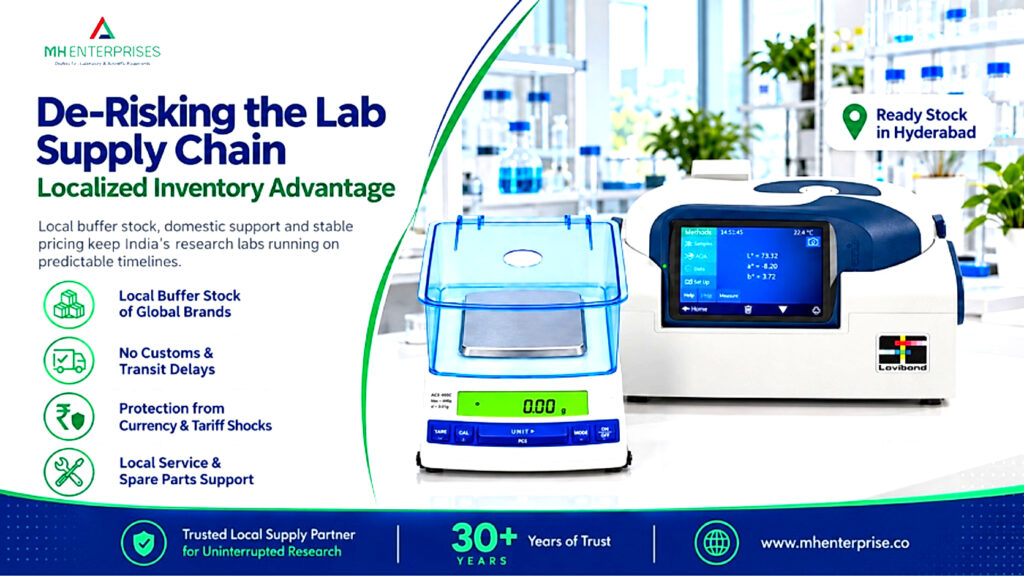
Modern research and development operations often work under tight timelines. Across India’s rapidly expanding biopharma, clinical, and academic sectors, even a single day of downtime caused by a delayed reagent or missing component can disrupt critical schedules, jeopardize testing programs, and increase institutional costs. Although global distribution channels were once considered a benchmark for cost efficiency, today’s macroeconomic environment presents new risks. Cross-border logistics are increasingly vulnerable to disruption, making an exclusively just-in-time global model a potential financial liability for high-stakes research environments.
MH Enterprises bridges this supply-chain risk with a proven localized procurement model, combining access to established global brands with domestic stock availability and coordinated technical support. As a trusted lab supply company, it helps Indian research teams secure critical equipment and supplies on predictable timelines, giving procurement leaders a practical foundation for moving from vulnerable international sourcing to stable, locally supported operations.
This localized model reflects a broader shift in laboratory procurement. To achieve operational stability, procurement officers and laboratory directors are restructuring their procurement frameworks. They are shifting away from fragmented international ordering chains and turning toward reliable laboratory supply companies that maintain active local buffer stock. When domestic inventory hubs are positioned close to emerging bioclusters, operations move from reactive firefighting to a predictable, scheduled flow of critical assets.
1. The Cost of Velocity: Global Bottlenecks and Customs Stalls
When a research facility attempts to source complex instrumentation directly from global manufacturers, the true cost of the asset is rarely the sticker price. Instead, it is the cumulative risk of international transit. Global shipping lanes are exposed to geopolitical flashpoints, deep-sea port congestion, and intermodal freight backlogs. These friction points turn a standard four-week lead time into a multi-month logistical nightmare. For an R&D facility, these delays do not just represent missing boxes on a loading dock; they represent idle researchers, wasted overhead, and delayed time-to-market.
Customs clearance adds another layer of unpredictability. Complex analytical instruments frequently face intensive regulatory reviews, tariff-classification queries, and documentation checks at ports of entry. If a port authority holds a shipment because of missing paperwork or a compliance dispute, the importing laboratory faces escalating demurrage charges while its internal R&D deadlines slip.
Transitioning Risk to Domestic Networks
By shifting procurement to regional networks, institutions transfer much of the customs clearance and international transit burden to a specialized local partner. Experienced distributors manage compliance, tariff definitions, and ocean freight logistics long before the end user places an order. For organizations coordinating with laboratory equipment suppliers in Hyderabad, this strategic shift ensures that critical systems are already stored in India, completely insulated from overseas logistical gridlocks.
2. The Buffer Advantage: Sourcing Global Brands Locally
The most effective way to eliminate supply chain volatility is to build a localized buffer inventory. However, maintaining large quantities of specialized items on-site is rarely feasible for single research facilities due to high warehousing costs and strict environmental storage demands. The optimal financial solution is to leverage the infrastructure of domestic partners who maintain local stock of elite international brands.
MH Enterprises acts as this vital localized buffer link for the Indian research community. By partnering with globally recognized brands including Shimadzu, Remi, Neuation, Lovibond, and Systronics, MH Enterprises keeps critical inventory within arm’s reach of domestic laboratories. This model gives procurement teams immediate access to tier-one international technology without forcing them to take on the financial risks of direct importing.
3. Securing Seamless Inventory Synchronization
Sourcing hardware from established laboratory supply companies allows local teams to effectively eliminate the extended lead times that derail critical experiments. Rather than waiting months for a custom configuration to cross oceans, facilities can tap into existing domestic pipelines. This infrastructure gives research teams working in Andhra Pradesh and Telangana an immense competitive advantage, allowing them to secure immediate, on-demand deliveries of vital equipment instead of waiting on unpredictable overseas shipments.
4. Financial Defense: Hedging Against Currency and Tariff Shocks
Direct importation exposes laboratory budgets to severe financial volatility. International procurement is typically denominated in foreign currencies, leaving long-tail purchase orders deeply exposed to sudden currency fluctuations. A sharp drop in the value of the Indian Rupee (INR) between the initial quote date and the final invoice presentation can instantly blow past an institution’s capital expenditure budget.
Furthermore, international trade regulations and tariff structures remain unpredictable. A sudden spike in import duties on analytical equipment can add significant, unexpected costs to an active procurement cycle. When a facility attempts to manage these cross-border purchases independently, it must either absorb the cost overruns or cancel the purchase order entirely, forcing the research schedule back to its starting point.
Insulating Budgets from Foreign Exchange Fluctuations
Localized inventory helps reduce this financial vulnerability. Procurement through an enterprise-grade lab supply company guarantees that the domestic distributor assumes all exchange-rate risks, shielding the buyer from macroeconomic shifts. Utilizing regional partners like laboratory equipment suppliers in Hyderabad allows institutions to execute long-term procurement plans with complete pricing certainty, keeping capital expenditure aligned with initial budgetary projections.
5. Technical Continuity: The Critical Role of Localized Support
Securing a piece of laboratory equipment is only the first step in protecting a research timeline; maintaining its operational integrity over its entire working life is where the real value lies. If an advanced analytical system fails during a critical testing phase, the time spent diagnosing the issue, sourcing replacement components, and scheduling an engineer represents a direct threat to the research project. If those replacement parts and specialized engineers must be flown in from overseas, a minor component failure can easily cause weeks of costly downtime.
True supply chain resilience requires local access to both hardware and qualified technical support. Sourcing through comprehensive laboratory equipment service companies guarantees that technical support, installation compliance, and emergency calibrations happen inside domestic timeframes. This operational reality highlights why modern laboratories prefer working with integrated providers that pair extensive product catalogs with dedicated engineering teams who maintain local stocks of critical spare parts.
Mitigating Downtime via Regional Technical Nodes
For facilities operating in major biotechnology hubs, having a direct relationship with localized distribution networks can shorten the response path for service coordination, troubleshooting, and spare-part access. This comprehensive approach helps keep critical infrastructure running reliably and protects ongoing research investments from avoidable operational gaps.
6. Evaluating Total Cost of Ownership (TCO) in Lab Sourcing
To fully appreciate the financial case for localized inventory management, laboratory management teams must look past the initial purchase price and thoroughly evaluate the Total Cost of Ownership (TCO). Many procurement systems incorrectly evaluate options based solely on individual line-item unit pricing. This short-sighted approach completely overlooks the long-term operational costs that accumulate when dealing directly with overseas distribution channels.
A realistic TCO calculation must include the hidden costs of extended administrative delays, unexpected storage fees, internal logistics management, and the high cost of emergency shipping when specialized parts are missing. When an instrument sits idle for lack of a local technician or a simple validation kit, the financial loss scales up rapidly every single day.
Protecting Capital Investments Across Asset Lifecycles
Mitigating these ongoing operational leaks requires an intentional change in vendor criteria. By strategically shifting to trusted laboratory supply companies, modern organizations can convert these unpredictable variables into stable, fixed overhead profiles. For research facilities expanding in the region, relying on specialized laboratory equipment service companies lowers holding costs by keeping inventory off the balance sheet until the precise moment it is required on the bench. This optimized arrangement balances hardware procurement with long-term preventative maintenance schedules, maximizing instrument lifetimes.
7. Strategizing the Procurement Shift with MH Enterprises
MH Enterprises serves as a local supply-chain partner for Indian research facilities by combining access to international instrumentation with domestic inventory and responsive technical support. Its locally managed network helps laboratories reduce exposure to overseas shipping delays, exchange-rate uncertainty, customs bottlenecks, and extended service lead times, making procurement more predictable from purchase planning through installation and maintenance.
Transitioning your procurement from an unpredictable, transaction-by-transaction model to a stable, strategic framework requires trusted domestic execution. Partnering with a dedicated lab supply company ensures that your internal procurement teams spend less time chasing custom filings and tracking delayed shipping freighters, allowing them to focus on active lab optimization.
Creating an Unbroken Scientific Workflow
For organizations working with laboratory equipment suppliers in Hyderabad, MH Enterprises provides access to global instrumentation brands through a responsive, locally managed network. This approach helps stabilize procurement planning, reduce exposure to cross-border delays, and keep scientific teams focused on discovery and innovation. By turning supply continuity into a managed advantage, localized sourcing can become a predictable engine of scientific progress rather than a vulnerable point of failure.
If your laboratory is planning new equipment procurement, upgrading existing systems, or looking for dependable local support, connect with MH Enterprises to explore suitable laboratory equipment, consumables, and service options for your facility.