

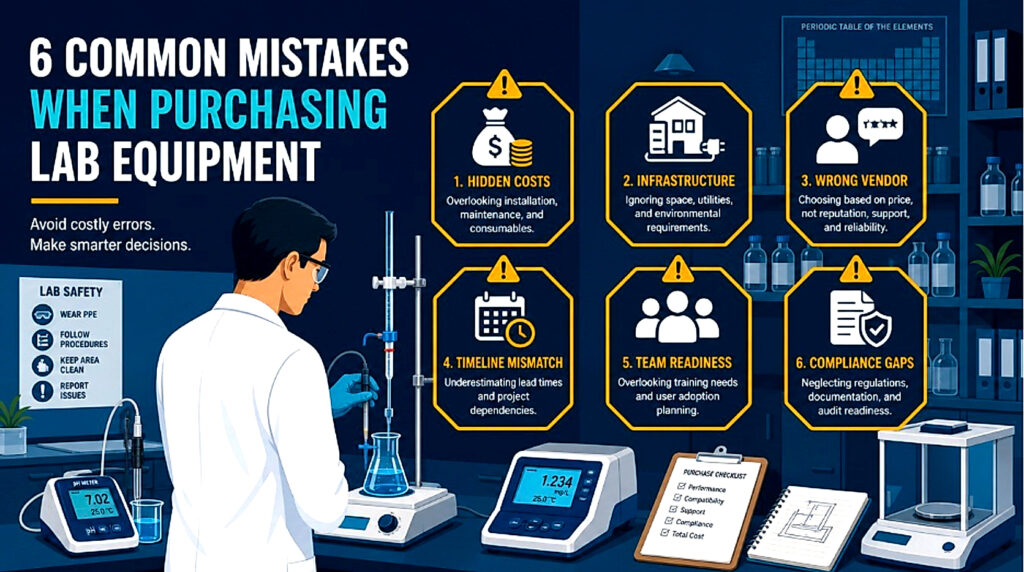
Every year, science laboratories across India face costly setbacks due to poor equipment purchasing decisions. From research institutions to quality control facilities, the wrong choice of laboratory instruments can lead to wasted budgets, unexpected downtime, and compromised data integrity.
Many procurement managers and lab heads make the same critical errors when buying a science instrument. They focus on prices without considering long-term costs, skip infrastructure checks, or rush decisions without proper evaluation.
This guide reveals the 7 most common mistakes when purchasing scientific laboratory instruments and provides actionable solutions to avoid them. By the end, you’ll have a practical checklist to make confident, cost-effective purchases for your science laboratories.
Mistake 1: Ignoring Hidden Long-Term Expenses
The biggest error buyers make is focusing solely on the purchase price of a science instrument. Many organizations buy the cheapest option without considering total cost of ownership, which includes:
- Annual maintenance contracts for laboratory instruments
- Calibration fees (required every 6 months)
- Consumables and reagents needed for operation
- Specialized software license renewals for scientific laboratory instruments
- Training costs for new staff
- Utility expenses (power, water, gas consumption)
How to Avoid It
Create a Total Cost of Ownership worksheet before purchasing:
Request detailed service contract quotes upfront and ask current users about their actual running costs. Quality laboratory instruments often cost less over 5 years due to reliability and lower maintenance needs.
Mistake 2: Not Checking If Your Lab Can Support the Equipment
Many science laboratories discover too late that their facilities cannot support the new science instrument. Common infrastructure gaps include:
- Equipment requiring 240V three-phase power in labs with only 120V single-phase outlets
- Scientific laboratory instruments needing ultra-pure water systems when only distilled water is available
- Vibration-sensitive laboratory instruments placed near heavy machinery or high-traffic areas
- Insufficient space for maintenance access or safety clearance
- Inadequate temperature or humidity controls for precision instruments
These oversights lead to costly retrofits, delays, or even complete equipment failure.
How to Avoid It
Create a comprehensive infrastructure checklist before purchasing:
- Power: Voltage, phase, amperage, stability requirements, backup power needs
- Space: Dimensions (including clearance for maintenance), floor load capacity
- Environment: Temperature range, humidity limits, vibration sensitivity
- Utilities: Water purity level, gas supply (type, pressure, flow rate), drainage
- Safety: Ventilation requirements, chemical storage, emergency shutdown access
Have your facilities team review requirements before finalizing the purchase. Schedule any necessary upgrades before equipment arrives to minimize downtime.
Mistake 3: Choosing a Vendor Based on Price Alone
Selecting a supplier only because they offer the lowest price for scientific laboratory instruments is a dangerous shortcut. Many buyers overlook critical factors like:
- Technical support availability (24/7 vs. business hours only)
- Local service representatives for your laboratory instruments
- Financial stability of the vendor (will they be around in 5 years?)
- Warranty terms and coverage limitations
- Response time for repairs or troubleshooting
Vendors with no local service presence force you to wait weeks for international technicians, causing extended downtime in your science laboratories.
How to Avoid It
Talk to at least 3 current users of the vendor’s science instrument before purchasing. Ask about:
- Service response times and quality
- Technical support helpfulness
- Actual warranty claim experiences
- Vendor communication and reliability
Check the vendor’s financial stability through business directories. Review service contract terms carefully, including SLA (Service Level Agreement) commitments. If possible, visit a lab using the same laboratory instruments to see them in action.
Note: Vendors who won’t provide references or have unclear service terms should be avoided.
Mistake 4: Rushing the Purchase Without Proper Evaluation
Last-minute budget spending is a common driver of poor purchasing decisions. Many science laboratories rush to buy scientific laboratory instruments before:
- Researching multiple vendors or models
- Getting competitive quotes and negotiating terms
- Evaluating workflow impact on daily operations
- Planning for installation and validation
- Allowing time for staff training
This rush leads to selecting equipment that doesn’t meet actual needs or costs more long-term.
How to Avoid It
Start planning months before you need the equipment. Create a realistic timeline:
| Phase | Duration | Key Activities |
| Research & Evaluation | 2–3 months | Identify needs, compare vendors, request demos |
| Budget Approval | 1–2 months | Prepare justification, get sign-off |
| Site Preparation | 1–2 months | Infrastructure upgrades, safety checks |
| Delivery & Installation | 2–4 weeks | Coordinate shipping, setup, commissioning |
| Training & Validation | 2–4 weeks | Staff training, performance testing, documentation |
Mistake 5: Not Consulting the People Who Will Use the Equipment
Procurement managers sometimes purchase automated scientific laboratory instruments without consulting the technicians who will operate them daily. This leads to:
- Equipment with interfaces that don’t match user preferences
- Overly complex science instruments in labs where staff lack specialized training
- Workflows that don’t integrate well with existing processes
- Low adoption rates and frustration among lab staff
Buying laboratory instruments without user input is a recipe for underutilization.
How to Avoid It
Form an evaluation team that includes:
- Daily users (technicians, researchers)
- Maintenance staff
- Lab manager or supervisor
- IT specialist (for connected scientific laboratory instruments)
Have potential users test the laboratory instruments during vendor demonstrations. Ask them to evaluate:
- Ease of use and interface design
- Training requirements
- Impact on daily workflows
- Maintenance accessibility
Consider everyone’s training needs and budget for comprehensive onboarding. When users are involved in the selection process, adoption rates improve significantly.
Mistake 6: Ignoring Regulatory Requirements & Safety Standards
Some organizations find out too late that their new science instrument requires special permits or certifications. Common regulatory gaps include:
- Laboratory instruments lacking required safety certifications (ISO 9001, CE, FDA, GLP)
- Systems producing hazardous waste requiring specialized disposal
- Equipment not meeting CAP, CLIA, or other industry-specific standards
- Missing documentation for audits or inspections
These oversights can lead to fines, shutdowns, or invalidated research data.
How to Avoid It
Review relevant regulations early in the purchasing process:
- Industry standards: ISO, CE, FDA, GLP, GMP requirements
- Safety certifications: Electrical safety, radiation safety, chemical handling
- Environmental regulations: Waste disposal requirements, emissions limits
- Documentation: Calibration certificates, maintenance logs, user manuals
Check certification requirements for your specific scientific laboratory instruments. Assess safety risks and plan for necessary controls like ventilation, spill containment, or emergency shutdown systems. Document all compliance requirements before purchase.
Your Lab Equipment Purchase Checklist
Before Purchase
- Create a detailed requirements checklist
- Get real user feedback from other science laboratories
- Calculate total ownership cost (not just purchase price)
- Check infrastructure needs (power, space, utilities)
- Review safety and regulatory requirements
- Form an evaluation team including daily users
During Purchase
- Get everything in writing (warranty, service terms, timelines)
- Negotiate service contracts and spare parts availability
- Plan for installation and site preparation
- Document training needs and schedule sessions
- Set clear delivery and commissioning timelines
After Purchase
- Train all users properly before first use
- Set up regular maintenance schedules for laboratory instruments
- Keep detailed records (purchase documents, calibration certificates)
- Monitor performance and document issues
- Review costs annually to identify optimization opportunities
Why MH Enterprises Is the Ideal Place to Buy Laboratory Instruments
When you’re ready to purchase a science instrument for your science laboratories, MH Enterprises stands out as the ideal partner for several reasons:
Broad Product Range
MH Enterprises offers an extensive catalog of laboratory instruments, including:
- Laboratory pH meters with high accuracy and durability
- Magnetic stirrer baths for precise temperature control
- Karl Fischer Titration Apparatus for oil industry applications
- Bomb Calorimeters for fuel and energy testing
- Rocking Platform Shakers for biochemical experiments
Local Expertise & Support
Unlike international vendors with limited local presence, MH Enterprises understands the specific needs of Indian science laboratories. Our team provides:
- Technical consultation tailored to your application
- Local service representatives for quick troubleshooting
- On-site installation and commissioning support
Comprehensive Service
- Transparent pricing with no hidden costs
- Competitive service contracts for scientific laboratory instruments
- Genuine spare parts availability
- Regular calibration services to maintain accuracy
User-Centric Approach
- Product demonstrations at your facility
- Training programs for your technicians
- Post-purchase support to ensure smooth adoption
Trusted by Industry
With years of experience serving science laboratories across India, MH Enterprises has built a reputation for:
- Reliable laboratory instruments that meet international standards
- Timely delivery and professional installation
- Responsive customer service and technical support
- Competitive pricing without compromising quality
Ready to make a confident purchasing decision?
Contact MH Enterprises today for expert guidance on scientific laboratory instruments, technical support, and competitive pricing. We help science laboratories across India choose the right science instrument for their specific needs and budget.