

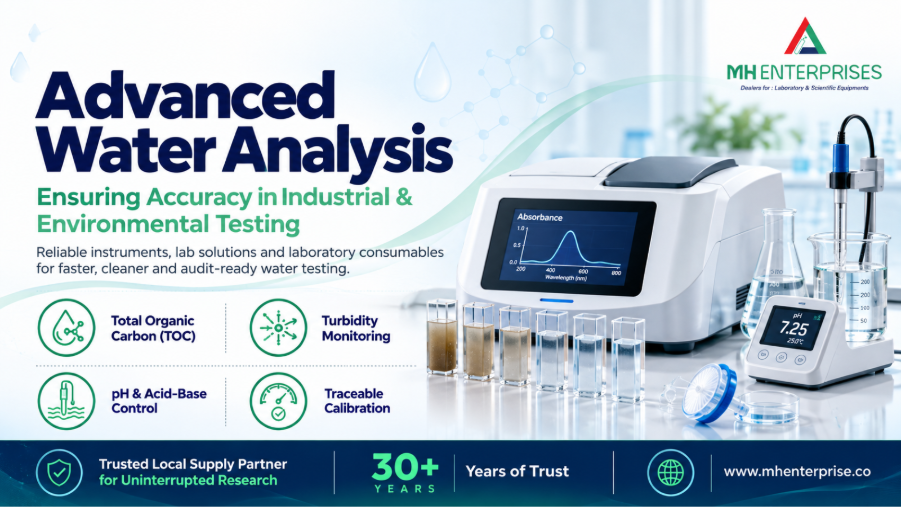
For laboratories, facility managers, and environmental compliance teams, the right combination of instruments, lab solutions, and laboratory consumables can make water testing faster, cleaner, and easier to validate.
Industrial and environmental water testing now demands more than basic visual checks or simple field indicators. As regulatory expectations grow, processing plants need reliable data to verify effluent quality before discharge. Advanced water analysis gives facilities the precision required to detect trace contaminants, protect natural water networks, and maintain confidence during inspections.
To maintain accuracy in demanding testing environments, facilities should use high-quality analytical instrumentation, calibrated support equipment, and dependable consumables. Working with an experienced scientific supply company helps laboratories keep testing metrics stable during continuous workloads, complex sample conditions, and strict compliance reviews.
Mapping Essential Environmental Metrics in Industrial Fluid Environments
The analysis of industrial wastewater involves tracking highly complex chemical and physical variables. Because manufacturing effluents contain dynamic chemical mixtures, ranging from organic byproducts to dissolved heavy metals, testing centres must monitor multiple specific parameters simultaneously to verify compliance and environmental safety.
Critical Parameters in Wastewater Testing
Total Organic Carbon (TOC) measures the total carbon load within organic matter, serving as a primary index of liquid cleanliness. In a highly active manufacturing facility, organic compounds can leak from cooling systems, wash bays, or processing lines. Monitoring this metric allows labs to calculate potential oxygen depletion risks in receiving waterways before discharge. High TOC levels can rapidly reduce dissolved oxygen in aquatic habitats, depleting fish populations and contributing to ecological dead zones.
Turbidity tracks fluid clarity by measuring how suspended microparticles scatter directed light beams. Unlike settling solids, sub-micron particulates and colloidal suspensions remain suspended in fluid columns indefinitely. High readings indicate high particle densities that can block sunlight, choking off underwater photosynthesis and disrupting aquatic plant lifecycles. Measuring turbidity requires multi-angle optical sensors that can differentiate true particle scattering from natural fluid coloration.
Monitoring pH goes far beyond basic litmus indicators. Modern facilities track active hydrogen ion shifts using automated glass electrodes to identify rapid acid-base spikes before they damage local treatment infrastructure. Chemical neutralization systems rely on instant pH data inputs to dose correction chemicals accurately. A minor processing failure that causes a surge in acidity can destroy beneficial biological cultures inside wastewater treatment basins, resulting in costly system shutdowns and severe regulatory fines.
To manage these parameters accurately, laboratories must move away from manual testing. Choosing automated analytical platforms from an authorized lab supply company allows testing centres to run simultaneous parameter assays efficiently, providing the foundation needed to monitor clean treatment phases safely.
The Role of Optical Validation in Standard-Driven Environmental Compliance
A persistent obstacle in high-volume water analysis is proving that your colorimeters and spectrometers deliver accurate data over long testing seasons. Environmental audits do not just review final parameter logs. They check the verification histories of primary detection tools. If a facility cannot prove its testing devices were calibrated perfectly during a specific run, its regulatory compliance data can be completely invalidated.
Creating Traceable Calibration Loops
To protect data integrity, laboratories must establish continuous, documented validation loops. This requires selecting high-performance spectrometers from a certified scientific supply company that provides traceable verification documentation. Modern instruments must be continuously audited across several distinct performance vectors:
- Traceable Absorbance Benchmarks: Utilizing certified liquid chemical arrays or solid-glass neutral filters to confirm wavelength accuracy across the entire spectrum. This ensures that the instrument’s optical components have not drifted over time due to ambient temperature changes.
- Stray-Light Filtering Control: Inspecting internal sample chamber seals regularly to prevent ambient room light from leaking into the sensor path and skewing low-level readings. Even a microscopic seal degradation can allow fluorescent room lighting to flood internal photo-sensors, artificially deflating a facility’s absorbance data.
- Wavelength Repeatability Diagnostics: Running automated calibration routines to confirm the system locks onto target bands perfectly, ensuring data consistency between different shifts.
By implementing these automated verification loops, facilities eliminate the risk of instrument drift, keeping your testing records fully prepared for unexpected environmental audits.
Overcoming Chemical Matrix Interferences in Colorimetric Testing
The most difficult challenge in industrial fluid analysis is background chemical interference. Unlike clean environmental samples taken from pristine streams, industrial effluents are highly coloured, complex mixtures containing suspended solids, dissolved organic matter, surfactant chemicals, and heavy metal complexes that obscure standard optical pathways.
Clearing Background Noise in Complex Matrices
When an untreated sample is introduced into a colorimeter, these matrix components create significant measurement errors. Background colour can overlap with the target analyte’s light absorption peak, artificially inflating concentration reports and causing false validation alarms. Similarly, heavy particulate turbidity can block light vectors, confusing internal sensors and generating erroneous over-readings.
To overcome these matrix complications, laboratories must utilize specialized chemical preparation steps. Technicians use precision-formulated lab solutions, such as targeted masking agents and chemical chelators, to isolate interfering ions before testing. For example, when testing for trace phosphorus in the presence of heavy iron concentrations, specific chemical blockers must be added to prevent the iron from binding with colorimetric reagents.
Furthermore, running comprehensive automated blanking cycles allows the instrument to subtract background colour mathematically. Utilizing high-quality lab solutions alongside filtered blanks ensures the instrument reads clean signals for precise target measurement, eliminating the need for slow, manual chemical extractions.
Optimizing Consumables Logistics for Continuous Testing Velocity
Maintaining high daily throughput involves more than just selecting advanced testing platforms; the minor everyday consumables used across your workspace must meet equal standards of reliability. The journey from sample collection to raw data reporting is filled with opportunities for contamination if your routine lab materials are not strictly controlled.
Sourcing Consistent Testing Consumables
Every piece of plastic or glass inside your testing bay plays a vital role in protecting your data. Low-grade sample vials can leach plasticizers or trace ions into fluid samples over time, creating false peaks and compromising sensitive chemical readings. Similarly, utilizing unverified syringe filters can introduce background particulates, altering your turbidity metrics before the sample even enters the instrument.
To prevent cross-contamination and maintain testing velocity, laboratories should standardize high-purity disposable sample tubes, certified syringe filters, lint-free wipes, and other laboratory consumables. A dependable lab supply company can help facilities keep these essentials available, so preparation steps remain clean and high-volume fluid workloads move through processing bays without purity failures.
Designing an Efficient Fluid Diagnostics Workspace
The physical organization of an environmental testing facility heavily influences daily processing throughput, worker safety, and sample security. A chaotic, unoptimized laboratory floor plan can lead to sample mix-ups, instrument damage, and cross-contamination between raw effluent samples and pristine calibration baselines.
Spatial Partitioning and Material Flow
An optimized water analysis laboratory should be divided into distinct, isolated processing zones that reflect a linear, unidirectional sample flow. The intake bay must be physically separated from the main analytical core to isolate unrefined samples, environmental residues, and raw industrial containers.
- The Ingestion and Preparation Zone: This space should feature heavy-duty ventilation hoods, automated dilution systems, and chemical handling benches where raw samples are logged, filtered, and treated with specialized reagents.
- The Electrochemical Analysis Station: Positioned immediately following sample prep, this zone houses automated pH meters, conductivity probes, and dissolved oxygen stations. Keeping these wet chemistry probes grouped together prevents liquid spills from damaging sensitive optical equipment.
- The Optical Core Room: This environment must be strictly climate-controlled and vibration-isolated. Sensitive UV-Vis spectrophotometers, TOC analyzers, and mass spectrometers must be situated away from chemical vapours and raw wastewater handling to protect delicate mirror arrays and internal light paths from atmospheric corrosion.
Partnering with MH Enterprises for Total Water Compliance
At MH Enterprises, we understand that advanced industrial water monitoring requires absolute precision and reliable performance. Data integrity cannot be achieved by using unverified consumer-grade field meters for highly complex industrial effluent matrices. To remain compliant with strict regulatory frameworks and avoid catastrophic legal liabilities, your facility must deploy robust, professionally verified analytical hardware.
We specialize in supplying a premium catalogue of high-performance water quality platforms, customizable spectrophotometers, and specialized monitoring infrastructure. Our team of technical consultants works closely with facility managers to evaluate layout needs, source high-durability consumables from an established lab supply company network and deliver instruments that easily meet your target operational parameters.
Partnering with MH Enterprises helps laboratories reduce sample interference, control instrument drift, and standardize verified consumables across the full water analysis workflow. With the right instruments, lab solutions, and technical support in place, facilities can build reliable compliance programs and operate with greater confidence.