

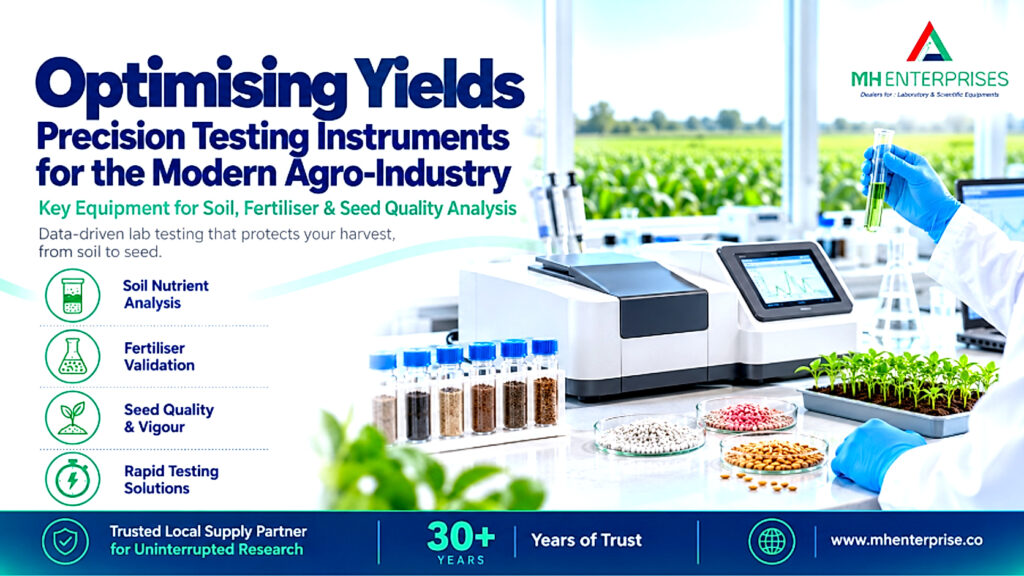
The global agricultural sector is facing an unprecedented challenge: maximising crop yields and food production while navigating shrinking arable land, volatile climates, and rising input costs. In this high-stakes landscape, farming can no longer rely on guesswork or historical intuition. Modern agriculture has evolved into an exact science, a data-driven industry where a single percentage shift in soil nitrogen or a minor drop in seed germination rates can dictate the financial viability of an entire harvest.
To bridge the gap between potential and actual crop performance, the modern agro-industry relies heavily on scientific validation. Advanced testing facilities across the supply chain act as the ultimate guardians of agricultural productivity. From assessing the chemical balance of regional soils to verifying the purity of synthetic inputs, deploying high-caliber research equipment is the primary mechanism through which modern agribusinesses protect their investments, secure market access, and optimise global food security.
Technical Foundations: Key Equipment for Soil, Fertiliser, and Seed Quality Analysis
At its core, agricultural yield optimisation is an exercise in resource management. Maximising outputs requires an intimate, molecular-level understanding of the primary variables governing plant growth: the growing medium, the nutritional supplements, and the genetic material itself. Achieving this level of insight demands a comprehensive fleet of specialized laboratory instruments designed to decode complex biological and chemical structures.
Deciphering the Soil Matrix
Soil is not a static substrate; it is a highly dynamic, chemically complex ecosystem. To formulate precise, field-specific prescription maps, agronomy hubs must perform thorough soil characterization. This characterization relies on essential workflows:
- Macronutrient Profiling: Quantifying available Nitrogen (N), Phosphorus (P), and Potassium (K) levels using advanced UV-Vis spectrophotometers and flame photometers.
- Micronutrient Mapping: Detecting trace levels of Boron, Zinc, Manganese, and Iron using high-performance atomic absorption spectrometers (AAS).
- Physicochemical Baseline Tracking: Utilising automated titration units and digital conductivity meters to monitor pH balance and salinity, ensuring the soil environment is optimised for maximum nutrient uptake.
Validating Fertiliser Chemistry
The commercial utility of synthetic and organic fertilisers depends entirely on compositional accuracy. If a manufacturer’s batch falls short of its stated NPK ratio, farmers will unknowingly under-fertilise, leading to widespread nutrient deficiencies across their fields. Conversely, over-fertilisation wastes expensive inputs and risks environmental contamination via chemical runoff.
To prevent these errors, production facilities utilise specialized laboratory analytical equipment to perform comprehensive quality control. High-pressure liquid chromatography (HPLC) systems separate and quantify specific nutrient fractions, while combustion elemental analysers confirm total nitrogen percentages within minutes. This rigorous verification guarantees that every bag of fertiliser shipped to a farm delivers precisely what is written on the label.
Safeguarding Seed Genetics and Vigour
The upper limit of any crop’s yield potential is genetically locked inside the seed. Before bulk seed lots are packaged and distributed globally, they must undergo extensive validation within an authorized research laboratory equipment layout.
Technicians utilise climate-controlled germination chambers to evaluate seed vigour under simulated environmental stressors. Simultaneously, near-infrared (NIR) seed analysers assess grain moisture contents and oil profiles non-destructively. This multi-layered screening ensures that only seeds with optimal germination velocities and high genetic purity make it to the planting line, eliminating the risk of crop failure at the absolute beginning of the agricultural cycle.
Overcoming Logistics Bottlenecks with Rapid Testing Solutions
In the fast-moving agricultural supply chain, data is only useful if it arrives in time to inform critical operational decisions. During the peak harvest and planting seasons, massive volumes of grains, fertilisers, and seed shipments converge on regional distribution centres, grain elevators, and international ports. If a facility relies on slow, outdated analytical methods to verify cargo quality, the entire logistics network stalls.
The Heavy Toll of Supply Chain Delays
When grain trucks are forced to idle outside a silo for hours waiting for manual chemical reports, or when cargo ships face custom clearance backlogs due to slow toxin screening, the financial consequences accumulate rapidly. Perishable commodities run the risk of spoiling, shipping demurrage fees climb, and processing facilities face sudden raw material shortages.
To bypass these operational hurdles, modern agribusiness hubs must transition away from slow, manual extractions and adopt automated, rapid-testing platforms. Partnering with a reliable technology provider like MH Enterprises allows testing centres to implement next-generation laboratory instruments engineered for speed and high throughput.
High-Speed Diagnostics on the Logistics Frontline
Modern rapid-testing solutions turn multi-day analytical protocols into highly efficient, minutes-long workflows:
- Automated Extraction Systems: Replaces manual shaking steps with high-speed mechanical modules to prepare soil and plant tissue samples for downstream analysis in seconds.
- Pre-Calibrated NIR Spectroscopy: Enables grain elevators to evaluate protein, moisture, and starch profiles instantly during bulk grain unloading.
- Rapid Mycotoxin Screening Kits: Utilises advanced lateral flow strips and compact digital readers to screen grain shipments for dangerous fungal toxins like aflatoxin on-site, ensuring immediate regulatory compliance.
By integrating these accelerated testing protocols into the workflow, an organization transforms quality assurance from a logistical bottleneck into a major competitive advantage, keeping valuable agricultural assets moving smoothly to their destinations.
Maintaining Long-Term Accuracy in Rugged, High-Throughput Environments
Commercial agricultural testing is fundamentally different from academic research. Instead of pristine, climate-controlled cleanrooms, agro-testing hardware is routinely deployed in demanding, industrial environments. Testing laboratories are often situated directly inside rural field stations, high-capacity grain silos, or dusty fertiliser blenders where they are continuously exposed to particulate matter, extreme temperatures, and heavy operational vibrations.
Operating high-precision research laboratory equipment under these intense field conditions introduces significant risks of mechanical wear and measurement drift. If an analytical instrument’s optical sensors become obscured by dust, or if its internal components warp due to fluctuating ambient temperatures, the accuracy of its data declines, leading to incorrect agronomic advice or costly compliance failures.
Engineering Hardware for Industrial Demands
To guarantee uncompromised data integrity over years of continuous operation, agro-testing facilities must select research equipment built explicitly for industrial resilience. Instruments should feature rugged structural attributes, including dust-resistant heavy-duty housing to shield delicate optical systems, and built-in vibration dampening to protect precision balances from structural floor vibrations caused by heavy machinery.
Overcoming Environmental Drift
Beyond physical protection, the software inside modern laboratory analytical equipment must feature automatic drift compensation. Advanced instruments utilise internal temperature sensors to monitor ambient shifts in real time, automatically adjusting internal optical alignments and sensor baselines to negate thermal drift.
Furthermore, integrating automated daily calibration routines using traceable, certified reference materials ensures that the system maintains a verified baseline. This combination of robust structural engineering and intelligent software control allows high-volume testing centres to operate continuously, delivering accurate data through intense harvest seasons.
Designing the Agile Agro-Testing Workspace
Maximising analytical throughput involves more than just buying single high-end instruments; those tools must be organized into a logical, streamlined workflow. The spatial planning of an agricultural laboratory heavily influences sample processing speed and safety.
Optimising Material Logistics
An efficient laboratory layout should follow a unidirectional path, keeping raw, dusty agricultural samples completely isolated from sensitive detection systems. The workspace should be structured into distinct functional zones:
- The Ingestion and Milling Zone: A rugged area equipped with heavy-duty grinders, particle sieves, and dust-extraction hoods to process bulk soils and grains.
- The Chemical Prep Bay: A dedicated space for automated liquid handling, acid digestions, and extraction chemistry.
- The Analytical Core Room: A highly stable environment reserved for sensitive mass spectrometers, chromatography setups, and advanced research equipment.
This intentional separation keeps abrasive particulates from contaminating delicate optical instruments, protecting your equipment investments and maximising daily testing volumes.
Choosing a Comprehensive Technology Partner
Building a resilient, high-throughput agricultural laboratory is a complex undertaking that requires specialized expertise. Organizations cannot afford to piece together inconsistent hardware components from disconnected suppliers, as this leads to software conflicts, training gaps, and maintenance headaches.
At MH Enterprises, we specialize in delivering fully integrated, high-performance testing ecosystems tailored specifically for the modern agro-industry. We curate a premium catalogue of rugged laboratory instruments, automated extraction systems, and specialized laboratory analytical equipment sourced from global manufacturers known for industrial durability. Our team of technical consultants handles everything from initial workspace layout design to instrument integration and regulatory validation, ensuring your facility operates at peak efficiency from day one.
Eliminating vulnerable testing methods, logistical delays, or instrument wear safeguards data integrity across the agricultural supply chain. Partnering with an industry leader to deploy robust research laboratory equipment ensures long-term testing accuracy and absolute confidence in your yield.