

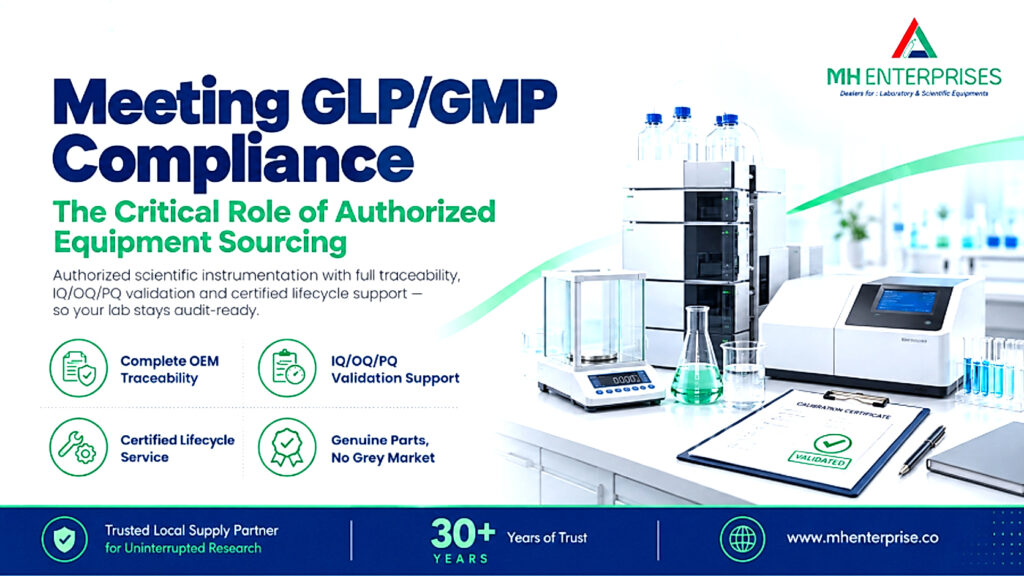
For laboratories operating in regulated environments, equipment sourcing is more than a procurement decision; it is a compliance decision. MH Enterprises supports pharmaceutical, biotechnology, clinical research, and industrial laboratories across India with authorized scientific instrumentation, dependable documentation, installation support, and lifecycle service that help teams maintain GLP and GMP readiness with confidence.
In the highly regulated world of pharmaceutical manufacturing, biotechnology, and advanced clinical research, compliance is not a checkbox exercise; it is the foundation of operational survival. Operating under Good Laboratory Practice (GLP) and Good Manufacturing Practice (GMP) frameworks requires absolute control over every variable within the testing environment. Among these variables, analytical instrumentation stands as the most critical infrastructure. When a facility undergoes a rigorous regulatory audit, whether by domestic bodies or international agencies, every piece of hardware on the bench faces deep scrutiny.
Maintaining this level of data integrity requires a deliberate and secure approach to procurement. For modern laboratories, establishing a secure pipeline for authenticated hardware means stepping away from grey-market discount brokers and building direct channels with authorized distributors. Procuring certified scientific laboratory equipment through authorized networks provides researchers with complete traceability, baseline calibration records, and full engineering support. By making a conscious decision to source through verified scientific equipment suppliers, QA/QC managers protect their facilities from regulatory observation letters, failed product batches, and validation failures.
1. The Audit Battlefield: Navigating Strict Global Regulatory Standards
A strict compliance audit can happen with limited notice, putting a facility’s standard operating procedures, documentation, and equipment records under scrutiny. During these inspections, auditors do not only review final test results; they examine the full history behind the data point. This includes the performance, validation history, and calibration pedigree of the instrument that generated the data. If an auditor identifies gaps in instrumentation records, the reliability of the dataset can come into question, potentially delaying production activities or clinical research timelines.
Navigating these strict global regulatory standards requires an unbroken chain of custody for every instrument on the floor. Regulatory inspectors look closely at the origin of your instruments to confirm they were sourced through legitimate, factory-certified supply networks. When a lab procures its hardware from unverified or third-party sourcing agents, establishing this clean data trail becomes nearly impossible.
Eliminating Traceability Vulnerabilities
To eliminate this vulnerability, regulatory compliance officers prioritize sourcing their assets through authorized channels. Utilizing authentic instrumentation provides the foundation for clear documentation, ensuring that every asset has a traceable history directly linked to the original equipment manufacturer (OEM). Working alongside factory-aligned partners allows lab managers to build a secure repository of manufacturing certificates and source verifications long before the audit team arrives on site. This proactive documentation approach ensures that your active laboratory testing equipment operates well within approved tolerances, completely removing the guesswork from compliance management. When an audit team reviews a facility stocked with verified quality lab equipment, the inspection transforms a stressful ordeal into a straightforward display of operational excellence.
2. The Verification Foundation: The Necessity of True Calibration and IQ/OQ/PQ
The path to true GLP/GMP compliance begins long before an instrument runs its first live sample. In regulated spaces, an unvalidated instrument is an unusable instrument. Every new asset must undergo a rigorous validation protocol consisting of Installation Qualification (IQ), Operational Qualification (OQ), and Performance Qualification (PQ). These validation steps provide documented evidence that the system arrived undamaged, was installed correctly within environmental tolerances, and performs consistently according to manufacturer specifications.
Authorized distributors play a vital role here by supplying factory-trained engineers, verified documentation, and traceably calibrated tools for installation and qualification support. MH Enterprises helps laboratories in India access this authorized support ecosystem for leading scientific instrumentation brands, helping ensure that systems are installed, calibrated, and validated in line with manufacturer guidance and audit expectations.
Securing Audit-Ready Validation Frameworks
When a laboratory invests in high-tier scientific laboratory equipment, securing authorized validation support is essential for protecting that investment. Sourcing certified scientific equipment suppliers provides more than just the physical machine; they deliver the official, audit-ready validation workbooks required to pass international inspections. This traceably executed paperwork confirms that your critical hardware has been calibrated using certified reference materials with an unbroken chain of traceability to national standards. By choosing to deploy fully certified setups, procurement teams protect their workflows from compliance gaps, ensuring that every injection, measurement, and data point can withstand strict regulatory review.
3. Hidden Dangers: The High Cost of Grey-Market and Unverified Instruments
In an effort to optimize capital expenditure budgets, some procurement departments fall into the trap of purchasing instruments through unverified parallel importers or grey-market brokers. While these channels might offer lower initial acquisition costs, the long-term financial and regulatory risks are severe. Grey-market instruments frequently lack authentic component tracking, software updates, and official warranty protections, which can create significant vulnerabilities inside a regulated laboratory environment.
From a compliance perspective, deploying unverified hardware can lead to serious validation failures. If a grey-market instrument contains non-standard internal components, unsupported software, or outdated firmware, it may generate data drift or analytical inconsistencies that compromise study reliability. By the time a calibration shift is discovered during review or audit, months of research data may need to be investigated, repeated, or rejected.
Mitigating Gaps in Equipment Authenticity
The financial fallout from these validation failures can easily eclipse any initial savings on the purchase price. When a facility relies on unverified hardware, they assume all operational risks without a safety net. If a system failure occurs, unaligned third-party dealers cannot provide the genuine parts or factory firmware updates required to restore compliant operations. This lack of support can leave critical laboratory testing equipment offline for weeks, stalling production schedules and delaying product launches. To avoid these costly operational blind spots, forward-thinking laboratory directors rely exclusively on fully authenticated quality lab equipment, ensuring that every component, chip, and software version is fully authorized by the original manufacturer.
4. Securing Compliance Through Authorized Lifecycle Support
Achieving GLP/GMP compliance is not a one-time milestone; it is an ongoing operational commitment that spans the entire working life of an instrument. Over years of continuous operation, analytical systems experience mechanical wear, optical degradation, and electronic drifts that must be actively managed. In a truly compliant environment, maintenance cannot be reactive; it must follow a structured, preventive schedule executed by certified technical teams.
When an instrument requires service or routine re-calibration, the technical qualifications of the technician are just as important as the components they install. Regulatory frameworks require that any individual modifying or calibrating a validated system must hold documented, factory-authorized training certifications. Utilizing unauthorized repair personnel can instantly void an instrument’s validation status, making all subsequent data legally non-compliant.
Protecting System Longevity and Validation States
This operational reality is why long-term compliance depends on full-service distribution partners. When a lab sources specialized scientific laboratory equipment through authorized networks, it gains access to a certified support ecosystem. Factory-backed scientific equipment suppliers can provide genuine, serial-tracked spare parts, diagnostic support, software updates, and structured re-qualification guidance. This support helps technical teams keep instruments serviceable without compromising validation status or disrupting active testing timelines.
5. Strategizing Long-Term Compliance with MH Enterprises
Building an audit-proof laboratory environment requires a deliberate sourcing strategy that balances procurement goals with strict quality control requirements. MH Enterprises provides the reliable local infrastructure needed to implement this secure sourcing model across India’s growing scientific sectors. By acting as an authorized gateway for world-class instrumentation brands, MH Enterprises ensures that local laboratories never have to compromise data integrity or regulatory compliance.
When modern laboratories upgrade their infrastructure, choosing the right distribution partner is essential for long-term stability. Selecting authentic scientific laboratory equipment ensures that your workflows are built on precise engineering and stable manufacturing baselines. Partnering with established scientific equipment suppliers allows your internal teams to operate with complete peace of mind, knowing that your documentation, software versions, and hardware platforms are fully aligned with current regulatory standards.
Creating a Sustainable Quality Culture
This strategic focus ensures that your critical laboratory testing equipment remains operational, reliable, and fully compliant throughout every phase of its lifecycle. Ultimately, by standardizing your operations around high-caliber, factory-certified quality lab equipment, your institution eliminates regulatory risks, protects its capital investments, and allows your scientific teams to focus entirely on research and innovation.
If your laboratory is planning an equipment upgrade or preparing for a GLP/GMP audit, MH Enterprises can help you source authorized scientific instruments with the documentation, installation support, and service continuity needed for compliant operations. Connect with the MH Enterprises team to discuss the right equipment and support model for your facility.