

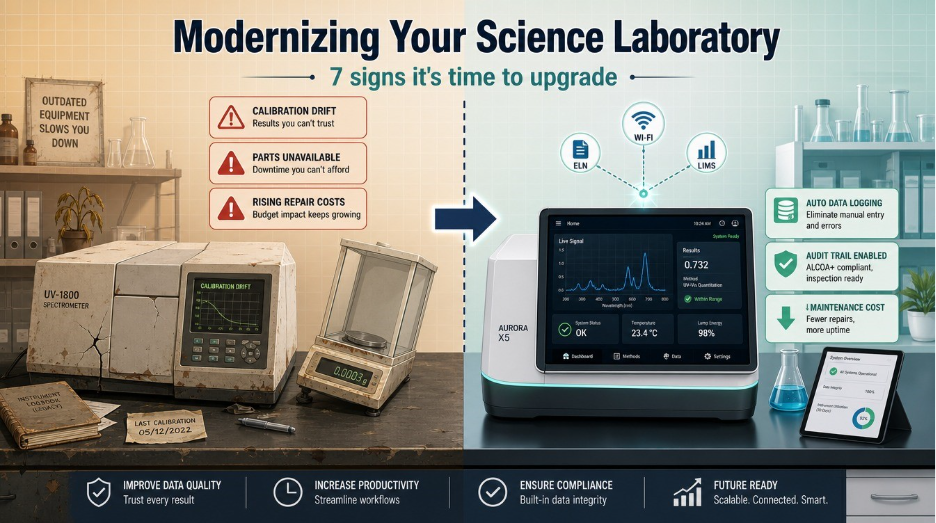
Many science laboratories still operate with instruments that are several years old. Age alone does not determine whether equipment should be replaced, but older systems can pose growing risks to data quality, efficiency, serviceability, and compliance if they no longer meet current performance or documentation requirements.
Outdated instruments can contribute to measurement variability, increased downtime, higher maintenance costs, and workflow inefficiencies. In regulated environments, the risk is especially high when equipment cannot be properly calibrated, maintained, qualified, or integrated into required documentation practices.
Modernizing often means replacing or supplementing aging laboratory instruments with newer systems that may offer improved precision, connectivity, usability, service support, and documentation capabilities. This guide helps laboratories identify practical signs that it may be time to upgrade equipment, estimate return on investment, and plan a smooth transition without disrupting operations.
By the end, you’ll have a checklist to evaluate your equipment and make data-driven upgrade decisions.
The Cost of Keeping Older Laboratory Instruments
- Accuracy and Data Integrity Risks
- Increased Downtime and Maintenance Costs
- Missing Digital and Connectivity Features
- Energy Inefficiency and Environmental Impact
7 Clear Signs It’s Time to Upgrade Your Laboratory Instruments
Sign 1: Frequent Breakdowns and Repairs
Frequent breakdowns, repeated service calls, or long repair lead times are strong signs that an instrument may be approaching the end of its practical life. A useful decision point is when repair expense, downtime, and performance risk begin to approach the cost and benefits of replacement.
Science instrument with recurring issues disrupts workflow in science laboratories, causing missed deadlines and frustrated staff.
If the answer is more than two, it’s time to consider replacement.
Sign 2: Calibration Drift and Accuracy Issues
If an instrument repeatedly fails calibration or cannot maintain performance within its required tolerances, it needs immediate attention. In some cases recalibration, maintenance, or parts replacement may restore performance; in others, persistent drift indicates that replacement is the safer option.
Measurements from outdated scientific laboratory instruments show increasing variance between repeated tests. Red flag: Your science laboratories are getting inconsistent results from the same test run multiple times.
When accuracy drifts beyond acceptable limits, trust in your science laboratories data erodes, affecting decisions from research to quality control.
Sign 3: Parts No Longer Available
Manufacturer has discontinued support for your science instrument, making repairs impossible. Replacement parts for laboratory instruments take months to source or are completely unavailable from vendors.
Vendors refuse to service aging scientific laboratory instruments in your science laboratories because they can’t guarantee functionality. Without parts, your laboratory instruments become unusable unexpectedly, causing critical delays.
When a vendor tells you “we don’t carry parts for that model anymore,” start shopping for replacements immediately.
Sign 4: Rising Maintenance Costs
Rising maintenance costs are a warning sign, especially when service becomes unpredictable, parts are harder to source, or specialist support is limited. Instead of relying on a universal percentage, compare annual maintenance and downtime costs against the replacement cost, expected uptime, and business impact of the instrument.
The cost of calibration, preventive maintenance, emergency repairs, and lost productivity can add up quickly on older equipment. In many cases, newer instruments justify their purchase through lower service costs, better uptime, improved data handling, and reduced error risk, but the payback period should be calculated case by case.
Track your annual spend on each science instrument, when maintenance approaches 20% of replacement cost, upgrade becomes financially necessary.
Sign 5: Manual Data Entry and No Digital Features
Science instrument requiring handwritten notes instead of automatic data logging introduces transcription errors. Laboratory instruments lacking USB, Ethernet, or Wi-Fi connectivity for science laboratories can’t share data with other systems.
Older instruments may not support contemporary data formats, audit trails, user controls, or straightforward integration with LIMS, ELN, or other digital systems. Manual data transfer increases the risk of transcription errors and can slow review, reporting, and traceability.
Digital transformation starts with connected laboratory instruments that automate data capture and reduce manual labor.
Sign 6: Non-Compliance With Current Regulations
In regulated environments, instruments and connected software may need to support requirements such as audit trails, controlled access, electronic records controls, qualification, calibration, and documented procedures. The exact requirements depend on the laboratory’s industry, geography, and intended use, so upgrade decisions should be aligned with applicable regulations and quality standards.
Older instruments may also make validation, qualification, or audit preparation more difficult if documentation is incomplete or software capabilities are limited. Compliance gaps can lead to observations, delays, rework, or restricted use of data, which is why instrument capability should be reviewed alongside laboratory procedures and quality systems.
If your current laboratory instruments can’t satisfy auditor requirements, upgrading is not optional, it’s mandatory.
Sign 7: Inefficiency Compared to Newer Models
Newer instruments often offer shorter analysis times, better automation, improved sensitivity, and easier data handling than legacy models. If your current equipment limits throughput, method capability, or service offerings, replacement may create measurable operational benefits.
Your laboratory instruments can’t handle modern sample types or testing methods required by new regulations. Falling behind industry standards puts your science laboratories at competitive disadvantage, losing clients to better-equipped facilities.
When competitors offer faster turnaround times with newer scientific laboratory instruments, your science laboratories loses market share.
Step-by-Step Guide to Upgrading Science Laboratories Equipment
Step 1: Audit Your Current Laboratory Instruments
Create complete inventory of all science instrument in your science laboratories, documenting:
- Age of each laboratory instrument
- Current condition and performance history
- Frequency of breakdowns and repair costs
- Which scientific laboratory instruments are critical vs. optional
- Laboratory instruments failing most frequently or causing delays
This audit reveals which science instrument deserves immediate replacement versus which can wait.
Step 2: Prioritize Based on Impact
Replace science instrument affecting quality-critical tests first, these pose the highest risk. Upgrade laboratory instruments used most frequently in science laboratories for maximum productivity gains.
Address scientific laboratory instruments with compliance risks immediately to avoid regulatory penalties. Consider budget constraints when planning science laboratories upgrades, focusing on high-impact equipment first.
Critical laboratory instruments should be upgraded before convenient ones, even if budget is tight.
Step 3: Set a Realistic Budget
Set a budget based on risk, instrument criticality, expected return, and the condition of your current equipment rather than a fixed percentage of annual spend. For high-value instruments, financing or phased replacement may be worth considering if capital is limited.
Include all lifecycle costs in the budget, such as installation, method transfer, training, qualification, validation, software setup, accessories, and ongoing service. A phased upgrade plan can reduce operational disruption and spread costs over time.
Realistic budgeting prevents project delays and ensures science laboratories can complete upgrades without cash flow problems.
Step 4: Choose the Right Replacement Science Instrument
Match precision requirements of your science laboratories, don’t overbuy for applications needing only basic accuracy. Ensure new laboratory instruments integrate with existing systems like LIMS, ERP, or cloud platforms.
Verify vendor support for scientific laboratory instruments in your region, including service response times and spare parts availability. Request demos to test science instrument before purchasing, ensuring it meets your actual workflow needs.
The right laboratory instruments balance performance, features, and cost for your specific science laboratories.
Step 5: Plan for Smooth Transition
Schedule installation during low-activity periods for science laboratories to minimize disruption. Train staff on new laboratory instruments before old science instrument is removed, ensuring no productivity gap.
Validate new scientific laboratory instruments according to regulatory requirements before using for production testing. Keep old laboratory instruments as backup during transition period, running parallel tests until confidence is established.
Careful transition planning prevents the chaos that often accompanies equipment upgrades in busy science laboratories.
Step 6: Dispose of Old Equipment Responsibly
Follow e-waste regulations when disposing of outdated science instrument, ensuring hazardous materials are handled properly. Sell or donate usable laboratory instruments to schools or smaller science laboratories that can benefit from functional equipment.
Recycle components of broken scientific laboratory instruments through certified e-waste processors. Document disposal for compliance records in science laboratories, especially for regulated industries.
Responsible disposal helps laboratories reduce environmental risk, protect sensitive data, and maintain appropriate records for internal governance or regulatory needs.
Pitfalls to Avoid During Equipment Upgrades
- Waiting Too Long to Upgrade Laboratory Instruments
- Buying Cheapest Science Instrument Without Considering TCO
- Ignoring Staff Training for New Scientific Laboratory Instruments
- Upgrading All Science Laboratories Equipment at Once
Your Equipment Upgrade Decision Checklist
- Age and Condition
- Performance and Accuracy
- Features and Connectivity
- Cost and ROI
Modernize Your Science Laboratories to Stay Competitive
Keeping outdated laboratory instruments in your science laboratories costs more than upgrading. Frequent breakdowns, inaccurate data, compliance risks, and inefficiency from old science instrument drain resources that could be invested in growth.
Modern instruments may offer better precision, digital connectivity, service support, energy performance, and documentation capabilities than older systems. By recognizing the warning signs and planning upgrades strategically, laboratories can reduce risk, improve efficiency, and strengthen long-term resilience.
Start with an audit of your current laboratory instruments, prioritize critical science instrument, and calculate ROI for scientific laboratory instruments upgrades. Phased modernization ensures smooth transitions without disrupting science laboratories operations.
Ready to modernize your laboratory? Contact MH Enterprises for guidance on evaluating upgrade priorities and selecting instruments that fit your workflow, quality requirements, and budget.